Comparative Economic Trajectories of India and Pakistan: Strategic Options After the India–EU FTA
By Mian Majid Ali Afzal
The signing of the India-European Union Free Trade Agreement (FTA) in the end of January 2026 is a breakthrough in the South Asian geo-economics history. Engineering and textile tariff for India elimination is the subject of headlines, however in the case of Pakistan, the agreement is a mirror image. It shows 30 years of diverged economic trajectories and compels a reality check that the structural advantage of Pakistan in Western markets is being destroyed in a systematic and orchestrated way by its neighbor with its superior scale, diversification as well as strategic foresight. Much like China’s approach to countering the United States, India is pursuing geopolitical advantage through economic integration rather than military confrontation.
Deviant Trajectories: A Three-Fourths-of-a-Century Diagnosis
In order to understand the seriousness of the India-EU FTA, it is important to consider the statistics of 1990. India and Pakistan were then economically similar with each having a GDP per capita of approximately 370. Pakistan then had a more open trade-oriented economy. The decoupling of the countries occurred radically during the next decades.
By 2025, the nominal GDP of India was estimated to be approximately 4.18Trillion dollars, which is more than 10 times the size of Pakistan, which is 399 billion dollars. More importantly, the economic structure between India and Pakistan has shifted. India increased its market penetration of high value services, information technology and specialized manufacturing industries; its exports of services currently constitute more than 40 percent of its total trade. By contrast, Pakistan was still hooked to an export-based economy. In FY2025, the textiles and apparel accounted almost 60 percent of the total exports of Pakistan making the economy very vulnerable to shocks in the sector.
This deviation is not just the result of the quantitative scale but it is the expression of institutional capacity and trade diplomacy. Although India maintained two decades of negotiations with the EU to have a rules-based permanent FTA, Pakistan depended on the Generalized Scheme of Preferences Plus (GSP+) of the EU. Despite the fact that GSP+ was allowing zero-duty access to 66 percent of tariff lines, it was still a unilateral, conditional preference to so-called vulnerable countries. The recent achievement of India to negotiate zero-duty agreement to 100 percent of its textile lines under a commercial treaty between equals has practically nullified the major competitive edge of Pakistan.
The Structural Shift:
The India-EU FTA is not a one-time trade shock but a realignment of the supply chains. Pakistan enjoyed a 10-12 percent tariff advantage over Indian clothes in the EU in the last 10 years. By early 2026, that tariff shield has been practically gone.
The impacts on the Pakistani 8.8 billion-portfolio of export to the EU, which is about 27 percent of its total exports, are clear and far-reaching:
- Neutralization of GSP+: India is now at par with Pakistan in terms of textile duty-free status and ahead of it in such sectors as leather, footwear (Indian duties had earlier hit 17 percent.), and chemicals.
- Supply-Chain Lock-in: The FTA provides long-term assurance that motivates European companies to include Indian suppliers in their plans of “ChinaPlusOne”. The fact that India is able to manufacture the whole value chain of raw fiber to high-fashion clothing now overshadows the price competitiveness of Pakistan, which is already hurt by the skyrocketing energy prices.
Compliance and Standards: The EU-India deal includes a chapter called “Trade and Sustainable Development”. With India harmonizing its regulatory and environmental guidelines with the EU, Pakistan is also facing the threat of being left out of high-value, green supply chains, due to its slower pace in adopting ESG (Environmental, Social, and Governance) frameworks.
Strategic Cost of Economic Fragility
The inherent strategic limitation is the economic weakness of Pakistan. The historical dependence on aid-based stabilization and frequent IMF bailouts has placed Pakistan in the short-run liquidity at the expense of long-term industrial policy, which has inculcated a culture of crisis-management orientation towards trade. The depletion of foreign-exchange reserves of a country will result in a loss of bargaining power by the country when the reserves run out – the reserves of Pakistan have often been at a level that would only sustain imports of a few weeks. The India- EU FTA is an indication of a world where international order is increasingly shifting towards the “Mini lateral trade blocs”. In this new paradigm, the strategic relevance is quantified through the utility of the market; India has a consumer base of 1.5 billion, which is becoming a manufacturing option equated to many consumer markets, and hence it is deemed as an essential partner by the EU, but Pakistan has not diversified its economy; therefore, it is a fringe player.
Policy and Strategic Options: The Road to 2030
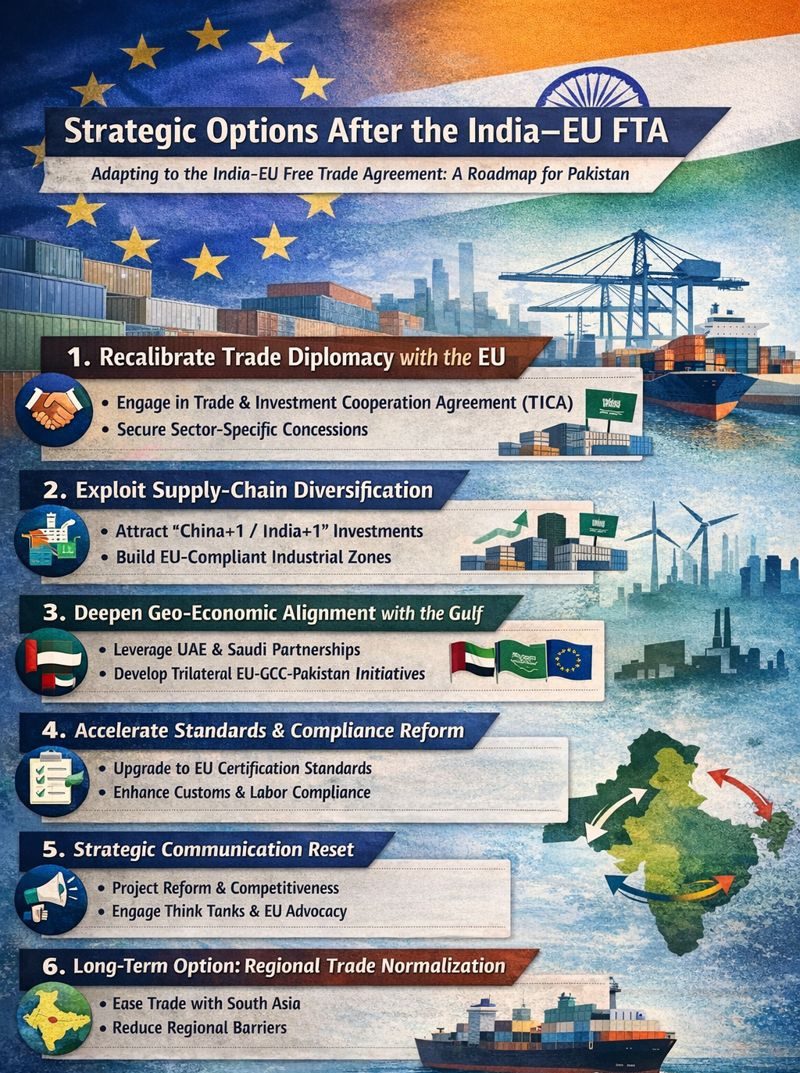
Pakistan cannot counter the India-EU FTA by empty rhetoric or additional demands on favors of sympathy. The answer has to be based on strict economic realism.
Moving Beyond the “GSP+ Crutch
It is time that Pakistan should start preparing for the post GSP + era. The current government will be reviewed in 2027. Instead of spending diplomatic capital on renewals, the state ought to shift to an Export Emergency that is driven by productivity. This will require the rationalization of the industrial energy tariffs, which are among the highest in the region, to make Pakistani manufacturers compete on the even level with the Indian and Vietnamese companies.
Sectoral Diversification and Industrial Upgrading.
The low-value textile (yarn and grey cloth) concentration is a strategic dead end. Policy should be a motivation to a transition to:
- Technical Textiles and MMF: The world has shifted to man-made fibre (MMF) , but the industry in Pakistan is still dominated by cotton.
IT and Services: India has a good model of exports in IT (more than 190 billion USD), for which Pakistan needs to break the regulatory barriers and the limitations of the internet connectivity, which is hindering its growing freelance and software-export industry.
Strategic Trade Diplomacy
The trade diplomacy of Pakistan should not be restricted only to the EU and US. These partners are still important; however, it is essential to integrate more deeply with the GCC (after the initial FTA) and approach the China Pakistan Economic Corridor (CPEC) Phase 2 – that is more likely to focus on B2B industrial collaboration than on the infrastructure only. The country should pursue being part of the regional value chains where it can provide specialized components instead of trying to compete on the raw level.
Conclusion: The Mirror of Realism
India -EU FTA is not something to fear but something to observe. It represents the climax of 10 years in which India sought strategic integration, and Pakistan suffered because of structural inertia. The days when Pakistan could use its vulnerability to gain access to the market are long gone. The Brussels accord is not a destination, but a transitional note: in the 21stcentury global economy, trade preferences are more of a bridge than a destination. The future of Pakistan as a competitive trading country is now dependent on its capacity to change its internal economic architecture. The country needs to move away from seeking concessions and move towards providing value; only then will it be able to negotiate a world where the neighbor nis ot only no longer a regional competitor but also a global economic anchor.
The writer is the author of “The Reforms” and serves as a Strategic and Administrative Adviser on South Asia Affairs for a CPEC-based project in Islamabad. He is also a Strategic Communication Adviser at the Institute of Strategic Communication & Economic Studies (ISCES). He can be reached at mianmajid582@gmail.com