By Momina Malik Awan
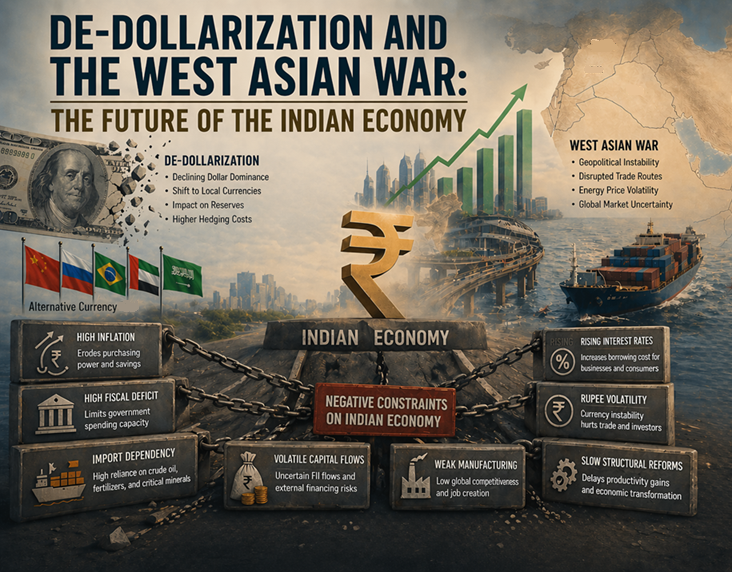
In 2026, the Indian economy is caught in a dual and highly consequential dynamic. The former is structural: the rapidly growing process of de-dollarisation of the world, led by the BRICS-based financial architecture, alternative methods of settlement, and aggressive internationalisation of Chinese yuan. The second is a contingent yet drastic: the US-Israel war on Iran that has disrupted energy flows, blocked essential maritime chokepoints, and put the Indian rupee under pressure, not experienced in its contemporary history. The nature of the interaction between these two forces, one of them representing a long-term opportunity, and the other being an immediate cost, is crucial to any serious evaluation of the future of the Indian economy over the next several months and years.
The Rupee in Freefall: What the Numbers Say
The currency figures narrate a clear story. On March 30, 2026, the rupee hit an all-time low of 94.654 per US dollar, and was trading at about 93.388 per US dollar on April 15, a level that would have appeared inconceivable just one year prior to that. The rupee breached the psychological barrier of ₹95 per dollar on March 31, consolidating its position as Asia’s worst-performing currency over the preceding year. The immediate trigger is the conflict. The Strait of Hormuz, a narrow passageway, essentially closed, means that India receives 90 percent of its LPG imports, and the effect was immediate and acute. Any change in the sourcing of crude oil may affect the volumes of cargo to be had at Indian ports, and the decline of the rupee may push the imported inflation and household expenditures very high. The figures that support this susceptibility are horrendous: according to the estimates by economists, any increase in crude prices by ten dollars per barrel can widen the current account deficit of India by up to 0.4 percent of GDP.
However, the weakness of the rupee could not be analytically complete because it is solely due to geopolitical shocks. Over the past five months, India has been recording a negative net FDI, and portfolio investments are leaving the country. Capital flows previously used to cover the trade deficit are now facing more crosswinds. The structural frailty has not been caused by the war, but has revealed an existing structural frailty.
Energy Shock: The Hormuz Chokepoint and India’s Exposure
Energy is no more important to India than any aspect of this crisis. The stakes are high with India, the third-largest importer of oil in the world, with a daily demand of more than five million barrels per day, and West Asia contributing almost 75 to 80 percent of the crude via the Strait of Hormuz. This is already being felt in the wider economy. Ranging at 5.5 percent in early 2026, inflation threatens to push up both fuel and petrochemicals in the 10s, tightening household incomes and business profit margins.
As this analysis progresses, the Hormuz scenario has taken a turn towards its worst stage ever. It was announced on Friday, April 17, that Iran would completely reopen the Strait of Hormuz at the time of the ceasefire, causing an immediate decline in oil prices plus a burst in world equity markets. But a few hours later, the situation swung the other way.
On Saturday, April 18, the Strait of Hormuz was reportedly restored to its usual condition by the Iranian state television, and Tehran was accusing the United States of not keeping its word and instead engaging in piracy and sea robbery under the pretext of the so-called blockade. President Trump proclaimed the strait completely open, but at the same time stated that the US naval blockade of the Iranian ports will stay in effect in full force until it is possible to arrive at a peace agreement. In the case of India, this 24-hour whiplash oil prices plummeting 12 percent when it opened the news at the time and then surging again once the Strait closed summarizes the real picture of the economic threat that it is. Not only is it the high energy prices, but there is also the paralysis of being chronically uncertain: Indian refiners are unable to hedge import deals, the RBI is unable to reliably protect a rupee floor, and industry is unable to plan its input costs when the most important oil chokepoint in the world opens and closes in a single news cycle.
There is stressful compounding in the agricultural sector. The imports of fertilisers (primarily from Iran and Russia), which constitute close to 40 to 45 percent of the total fertiliser imports in India, are experiencing serious delays, which could reduce kharif crop yields by 5 to 10 percent as projected by ICAR. As a nation in which rural consumption has played a crucial role in economic recovery, a break in the agricultural cycle at this point has macroeconomic consequences. In the April MPC meeting, RBI Governor Malhotra conceded that the high energy prices and other commodity prices, and supply shocks caused by Strait of Hormuz disruption, would be a drag on domestic production in 2026-27. The CPI inflation has been estimated by the central bank to reach 4.6 percent in FY27, a major increase, but it is still keeping its cautiously neutral policy position.
Trade, Remittances, and the Human Dimension
On top of energy, the war has disrupted India’s trade and remittance systems in a manner that has a bearing on millions of common citizens and thousands of companies. Three billion dollars worth of exports to Iran in the form of textiles, pharmaceuticals, and rice have decreased by 70 percent with the sanctions and the closing of ports at Bandar Abbas. The exports of basmati rice to Iran of over ₹6,374 crore in FY25 are experiencing over 180-day delays. The remittance channel, which is arguably the most important foreign exchange lifeline in India, is at stake. The Gulf is home to about 9.37 million Indians who face the threat of labour disruptions to the 38 to 40 percent of inward remittances that they produce. The UNDP report has cautioned that the crisis would drive close to 2.5 million Indians into poverty, and the absolute and relative economic losses of the conflict in South Asia would be the greatest.
The impacts are palpable on the ground. According to textile associations in Gujarat, half a million day labourers have lost their jobs, as an immediate downstream impact of the West Asian war. In March 2026, the activity in the manufacturing sector in India dropped to a 45-month low as the HSBC India Manufacturing Purchasing Managers Index dropped to 53.9 in March, the lowest in the index since June 2022.
India’s Resilience Buffers: Not Without Foundation
In the face of such pressures, the argument of economic collapse should not be exaggerated. India gets into this turbulence with significant buffers that the past generation of policymakers would not have boasted of. The foreign exchange reserves of India have gone up to 700.946 billion by the end of the week, April 10, 2026, after falling upon announcement of the outbreak of the conflict, with the RBI governor confirming that the reserves are sufficient to cover at least 11 months of imports. The RBI has observed that the fundamentals of the Indian economy are at a better position than in the past shocks, and the momentum in the services sector, the ongoing effect of GST rationalisation, increasing capacity utilisation in manufacturing, and healthy balance sheets of financial institutions continue to favour domestic demand.
The overall expansion perspective, though updated downwards, is decent. In April 2026, the IMF has slightly increased its FY27 GDP growth projection of India to 6.5 percent, observing that India will continue to be the fastest-growing major economy, driven by domestic demand, a favourable carryover effect, and better trade conditions. The growth in the real GDP in India is likely to decline due to the West Asia conflict by about one percentage point, and the retail inflation is likely to increase by about 1.5 percentage points above the base estimates, according to the estimations made by EY Economy Watch. These are major downgrades, yet they do not spell out a fundamental breakage in the growth story of India.
De-Dollarization: Cyclical Pain in Structural Opportunity
Ironically, it is these same geopolitical convulsions that are inflicting temporary harm on India but, at the same time, are hastening a structural change that is in its best long-term interests: the decline of the dollar as the global trade and finance medium. In March 2026, Indian refiners bought about 60 million barrels of Russian crude, and the transaction mechanism is as follows: Indian rupees are deposited in special overseas bank accounts of the Russian sellers, and converted to the UAE dirhams, a process that effectively circumvents the dollar-denominated SWIFT system altogether. The UAE and India have also agreed on how to settle the transactions in rupees and dirhams, as the world is undergoing a massive transformation in its trade.
The way India is placed in this move is both calculated and tactical. The official position of New Delhi is that it is not anti-dollar but pro-Rupee, a difference that is critical to escaping the 100 percent tariffs the United States is threatening to impose on countries that are actively attempting to abandon the dollar. This diplomatic calibration indicates that India is cognizant of the fact that it has to walk a fine line between two competing gravitational forces: the Western-dominated financial system pegged on the dollar, and the new BRICS-based multipolar system supported by China and Russia. Being the BRICS chair in 2026, India has added to the summit agenda an extended BRICS Bridge interoperability framework, in an effort to develop sufficient parallel infrastructure such that the dollar is not the only choice of settlement, but one among many. At the same time, the Central Bank Digital Currency of the BRICS countries has officially been suggested by the Reserve Bank of India to facilitate a more convenient cross-border payment of trade and tourism, i.e., to put it on the agenda of the 2026 BRICS Summit.
The strategic ambition is large. Should India manage to internationalise the rupee using BRICS payment rails, the digital rupee, and bilateral Vostro account agreements, India will benefit as having monetary sovereignty, lower transaction costs, and escape the pressure of US sanctions without having to face Washington head-on. It is not a break with the status quo but a hedging of the Indian financial bets, in a calculated and incremental way.
The Road Ahead: Policy Imperatives
The policy-makers in India have an uphill task of trade-offs in the next few months. In a world where currency defence and growth support are put under pressure at the same time, the RBI has to strike a balance between currency defence and growth support. The fact that energy subsidies are increasing and that the government must protect the vulnerable households against the cost-of-living shock limits fiscal space. At the strategic level, India needs to hasten the process of energy diversification in terms of origin and fuel type. India has shifted to discounted Russian crude, which currently makes up 40 percent of imports, as compared to 20 percent, and saved five to seven billion dollars in forex a year. In the long term, the crisis also accelerates domestic production, as investments by ONGC and Reliance in the Krishna-Godavari basin will serve to increase production by 200,000 barrels per day by 2027. The acceleration of renewable energy is already occurring and has an added sense of urgency as a strategic requirement, rather than a climate promise.
A more fundamental weakness has also been revealed by the war: India has not been able to gain any significant leverage in a world that is more and more being defined by crude geopolitical strength. The strategic control that China had over rare earths, as one analyst has said, provided it with asymmetric weapons with which to counter the pressure of the US in ways that India, even with its economic scale, is yet to match. The medium-term challenge the current crisis has brought into focused attention is to build that type of structural leverage based on critical mineral diplomacy, manufacturing depth, and financial architecture.
Conclusion
The future of the Indian economy in the short run will be determined by how long and how intense the West Asian war will be, to an extent which policymakers and markets have perhaps not fully discounted. Long war implies a long-term increase in energy prices, further weakening of the rupee, disruption of remittances, and a significant loss of the growth dividend that India had so hard worked to recover following the pandemic years. But the Indian economic fabric is still grounded. There are sufficient reserves, consumption in the country is solid, and the services sector remains strong. More to the point, the world monetary transformation that de-dollarization would entail provides India with a unique historic opportunity to be elevated to the next rungs of the global financial hierarchy, diminish structural dollar addiction, and become more entrenched in the newly multipolar financial system, so long as it can manage the short-term pain of policy discipline and strategic clarity.
Whether India can survive this storm is not the test. It can and will, history tells us. The question is, can it leverage this period of misfortune to leave behind a more independent, more robust, and more strategically independent economic structure than the one it began with? The fact that this conflict is no longer just abstract to India was reinforced when the reports of the IRGC gunboats firing upon a tanker that was trying to cross the Strait of Hormuz, through which Indian energy lifelines pass every day. In case Indian-associated vessels are direct targets of such aggression, New Delhi will have a much more difficult decision between economic expediency and strategic self-assertion than any amount of currency devaluation or inflation rate has till required of it.

Momina Malik is an Economist and Researcher serving as a Research Associate at the Pakistan Institute of Development Economics (PIDE), with an MPhil in Economics from Quaid-i-Azam University, Islamabad. A Gold Medalist and Roll of Honour awardee from Government College University Lahore, her research interests span Development economics, labour economics, and climate finance policy. She can be reached at momina@pide.org.pk