By Momina Malik Awan
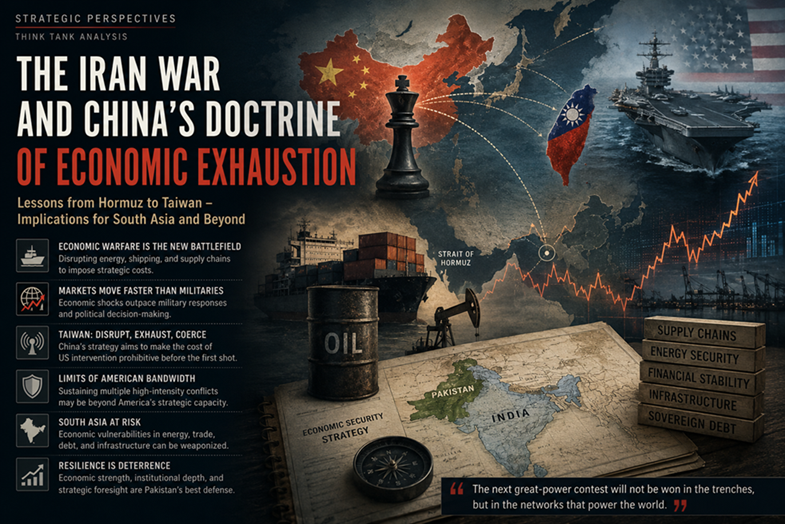
The US-Iran war is being discussed in most world capitals as a Middle Eastern crisis. In Beijing, however, it is being studied as something far more consequential: an operational blueprint for future great-power competition.
Iran’s Strategy Was Never Military Parity
Iran entered the conflict with no illusions regarding conventional military parity with the United States. What Tehran possessed instead was strategic patience and a precise understanding of where American power is genuinely vulnerable, not primarily on the battlefield, but within the structure of its global economic leadership.
By targeting Gulf energy infrastructure, threatening the Strait of Hormuz, and triggering spikes in global oil prices, Iran demonstrated something strategically significant. It showed that a determined and patient adversary can impose structural economic costs on the United States faster than Washington can politically contain them.
Tehran did not defeat the United States militarily. Instead, it revealed how economic disruption can generate strategic pressure disproportionate to conventional military capability. For Chinese strategists, this was not merely a regional conflict. It was a case study in asymmetric economic warfare.
The Emergence of the “Economic Escalation Ladder”
What Beijing observed was the emergence of what strategists may describe as an “economic escalation ladder,” a deliberate sequencing of pressure designed not to defeat American military forces directly, but to overwhelm the American decision-making process economically and politically.
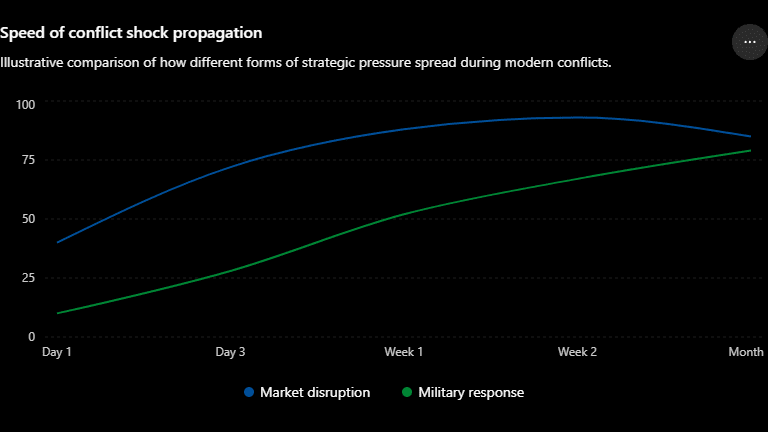
Iran steadily expanded the economic dimensions of the conflict while the United States largely responded in conventional military terms. The mismatch carried important implications. Markets reacted faster than aircraft carriers. Supply-chain disruptions spread more rapidly than diplomatic reassurances. Political messaging struggled to contain economic panic.
Repeated attempts by Washington to reassure financial markets demonstrated a deeper vulnerability: the economic consequences of strategic shocks are not constrained by military timelines. China has likely studied every stage of this disconnect carefully.
What Beijing Learned About Taiwan
The Taiwan dimension is where these lessons become strategically transformative.
For years, much of American strategic planning concerning Taiwan has revolved around a central question: could China seize the island before US forces arrive to prevent it? Yet this framing may fundamentally misunderstand contemporary Chinese strategic doctrine.
China does not necessarily require rapid military success. Chinese strategic thinking increasingly emphasizes disrupting an adversary’s operational, economic, and political systems rather than pursuing outright battlefield destruction.
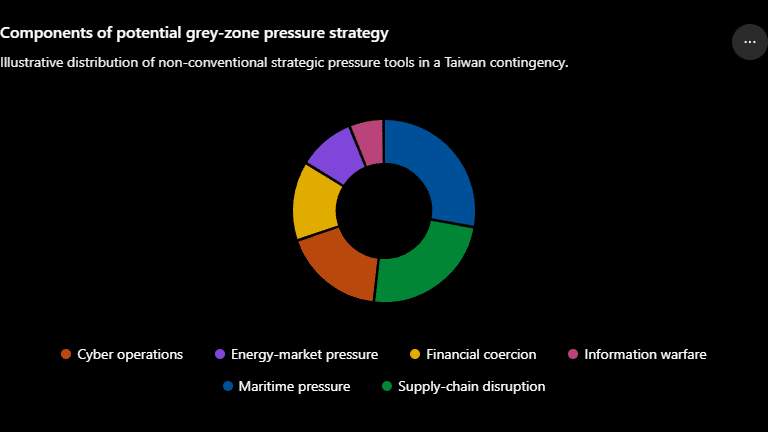
From this perspective, a Taiwan contingency may not initially resemble a traditional amphibious invasion. Instead, it could involve a carefully coordinated campaign of maritime pressure, cyber disruption, supply-chain manipulation, financial coercion, and energy-market instability designed to exhaust Taiwan politically while simultaneously increasing the economic cost of American intervention.
The objective would not simply be territorial conquest. It would be to make resistance economically unsustainable before large-scale military confrontation even begins.
The Limits of American Strategic Bandwidth
Another lesson Beijing likely extracted from the conflict is that the United States may struggle to sustain multiple high-intensity confrontations simultaneously.
The Iran war imposed a visible strain on American political capital, military logistics, economic stability, and diplomatic bandwidth. If this conclusion becomes embedded within Chinese strategic doctrine, then broader questions emerge regarding the long-term credibility of American security guarantees across the Indo-Pacific.
Deterrence ultimately functions only when adversaries believe that a state is both capable of and willing to absorb the cost of enforcement. Economic exhaustion complicates that credibility.
Why South Asia Cannot Ignore This Shift
From a South Asian perspective, this evolving doctrine carries serious implications.
The strategic playbook demonstrated by Iran and potentially adaptable by China does not remain confined to the Taiwan Strait or the Persian Gulf. It travels across regions where major powers compete economically rather than conventionally.
This places both Pakistan and India within an increasingly vulnerable geopolitical environment.
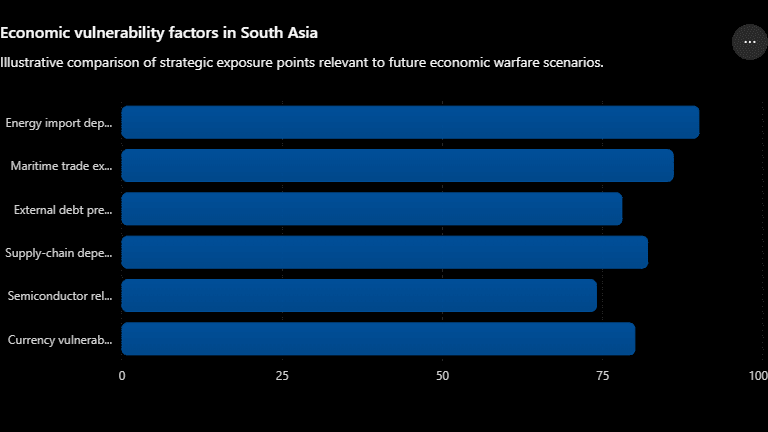
Pakistan remains deeply connected to Chinese infrastructure and financing initiatives through CPEC, while India’s economic structure remains highly dependent upon Gulf energy flows and Indian Ocean trade routes. In any future era of economic coercion, shipping lanes, debt structures, financial markets, and energy supply chains may become strategic pressure points.
Neither Islamabad nor New Delhi has yet fully developed a doctrine for navigating a world where the principal battlefield is economic, the weapons are supply chains and maritime chokepoints, and the central casualty is the assumption that military alliances alone guarantee national security.
Pakistan’s Challenge: Economic Resilience as Strategic Defence
For Pakistan, the appropriate response is neither panic nor passivity.
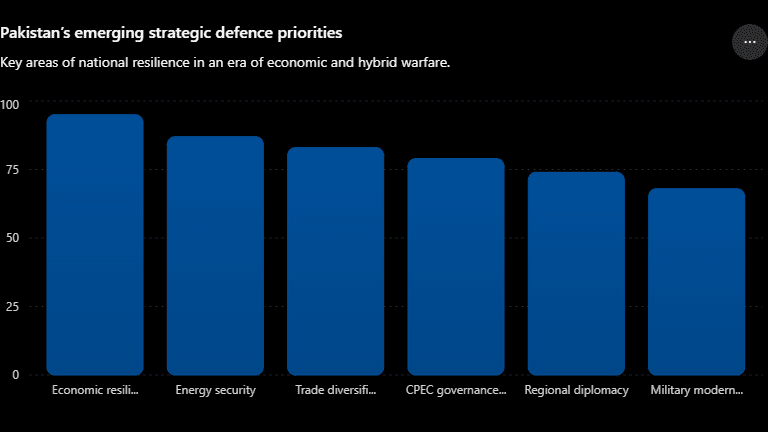
The era in which military alliances alone could guarantee national security is gradually fading. Economic resilience is increasingly becoming a form of strategic defence.
In practical terms, this requires three broad adjustments.
First, Pakistan must diversify the financing mechanisms associated with CPEC in order to reduce overdependence upon any single external actor.
Second, Islamabad should internationalize aspects of CPEC governance to improve transparency, attract broader investment participation, and reduce geopolitical vulnerability.
Third, Pakistan requires a foreign policy doctrine focused less on personalities and political alignments in Afghanistan and more on long-term regional economic interdependence, specifically identifying what neighboring states cannot afford to destabilize or lose.
The doctrine of exhaustion is not limited to superpowers. Smaller states can also employ economic leverage asymmetrically. Pakistan’s long-term defence therefore depends less upon external alliances and more upon economic discipline, institutional continuity, and strategic resilience.
The Battlefield of the Next Great-Power Contest
The Iran war may ultimately reshape far more than the Middle East.
While many observers will remember the conflict as a limited regional confrontation, Chinese strategists may record it differently. The moment asymmetric economic warfare evolved from theoretical discussion into a demonstrated strategic reality.
The next great-power contest may not primarily unfold through trench warfare or decisive naval battles. Its battlefield already runs through shipping lanes, semiconductor production, energy markets, digital infrastructure, sovereign debt, and global supply chains.
The question is no longer whether China learned from Iran. The real question is whether the rest of the world is learning fast enough to adapt.

Momina Malik is an Economist and Researcher serving as a Research Associate at the Pakistan Institute of Development Economics (PIDE), with an MPhil in Economics from Quaid-i-Azam University, Islamabad. A Gold Medalist and Roll of Honour awardee from Government College University Lahore, her research interests span Development economics, labour economics, and climate finance policy. She can be reached at momina@pide.org.pk