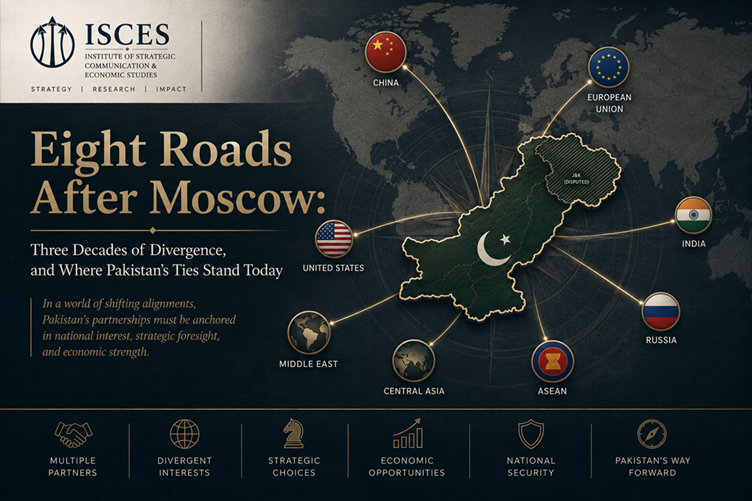
Three Decades of Divergence, and Where Pakistan’s Ties Stand Today
By Dr. Mahnaz Muhammad Ali, Co-Author Miss Farzeen Shaukat
Politically, the Soviet Union ceased to exist in December 1991. Economically, for the five Central Asian republics — Kazakhstan, Kyrgyzstan, Tajikistan, Turkmenistan and Uzbekistan — and the three states of the South Caucasus — Armenia, Azerbaijan and Georgia — dissolution came before any of them had the institutions, infrastructure, or markets to function as independent economies. Railways ran toward Soviet hubs rather than toward ports; industries had been assigned narrow roles inside a single planned system; and Russian remained, for years afterward, the language of administration and career advancement across much of the region. When the center collapsed, what was left was not one post-Soviet story but eight distinct inheritances, shaped over the following three decades by different mixes of resources, geography, conflict and governance choices. This matters to Pakistan specifically: all eight states are, in different ways, now looking for partners and routes beyond Russia, and Pakistan has spent the past two years positioning itself as one option. This article traces how each of the eight economies has developed since 1991, then examines where Pakistan’s relationship with each currently stands and what would genuinely improve it.
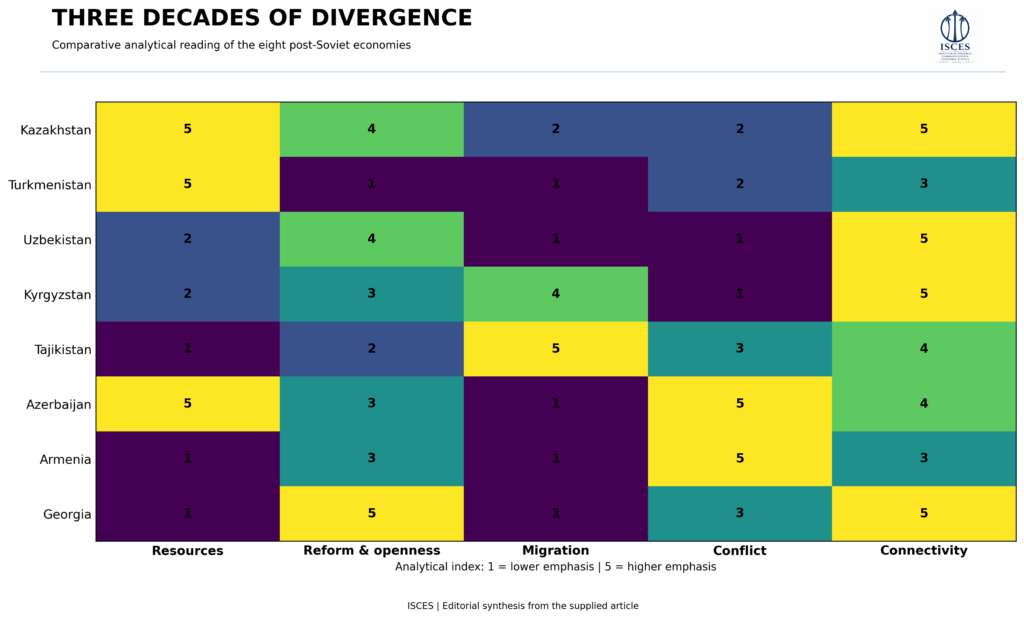
THREE DECADES OF DIVERGENCE
Resources Are Not Destiny
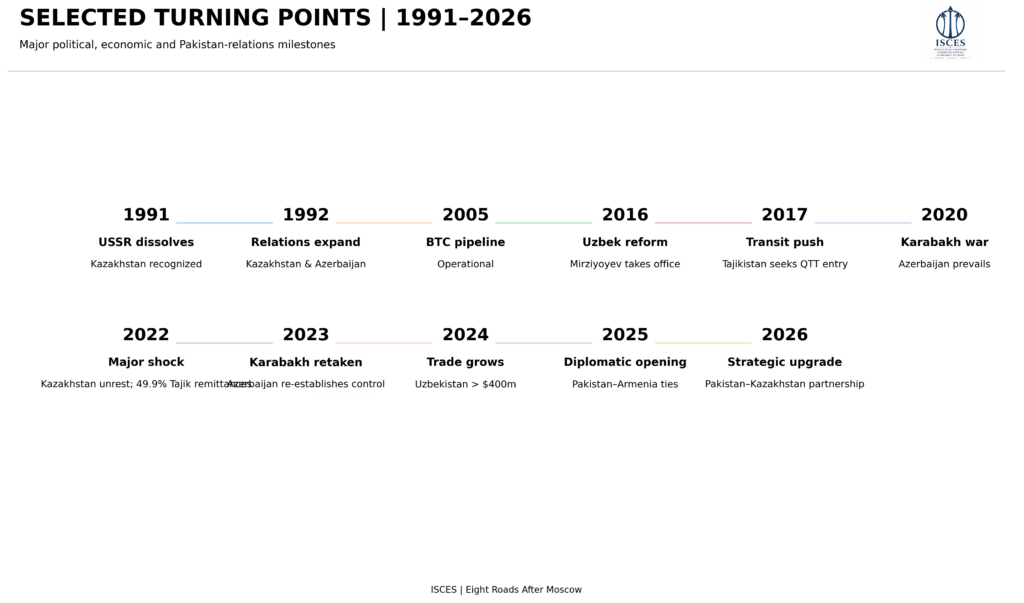
Kazakhstan and Turkmenistan illustrate this most clearly. Both entered independence with substantial hydrocarbon wealth: Kazakhstan with oil, uranium, and minerals across a vast territory, Turkmenistan with one of the world’s largest natural gas fields. Three decades later, their political economies look very different. Kazakhstan pursued a “multi-vector” foreign policy, keeping ties open with Russia, China, Turkey, Europe, and Western oil majors so no single partner gained a dominant hold over its resource sector. This gave Kazakhstan more room to maneuver than most neighbors. However, it did not resolve underlying problems: economic power stayed concentrated among the state and a small number of politically connected groups. Those tensions surfaced in January 2022, when fuel-price protests that began in the western town of Zhanaozen spread nationwide; the government’s crackdown killed more than 200 people by its own count, and the unrest forced out the prime minister’s government and stripped former president Nursultan Nazarbayev of his remaining formal role.
Turkmenistan took the opposite path, growing wealthy from gas while concentrating its exports on a single buyer: China, which now takes the large majority of Turkmen gas through the Central Asia-China pipeline system commissioned in 2009. The state remains deeply embedded in economic life, and Turkmenistan is one of the most closed economies in the world; gas revenue financed the reconstruction of Ashgabat as a city of white marble rather than a diversified economy. The comparison suggests that what a government does with resource revenue and how many partners it cultivates shape outcomes more than the endowment itself.
Reform Delayed, Then Accelerated
Uzbekistan shows how much difference a change in leadership can make. For roughly 25 years under Islam Karimov, who governed from independence in 1991 until his death in September 2016, Uzbekistan kept tight currency controls, heavy state involvement in agriculture, and strained relations with its neighbors. His successor, Shavkat Mirziyoyev, reversed course quickly: the currency was floated in 2017, forced labor in the cotton sector was substantially wound down, and borders with neighboring states reopened. What reform could not change is geography: Uzbekistan is one of only two doubly landlocked countries in the world, meaning goods must cross at least two international borders to reach any coastline — a constraint that has pushed Tashkent to seek new transit routes, including south toward Pakistan.
Economies Built on People Leaving
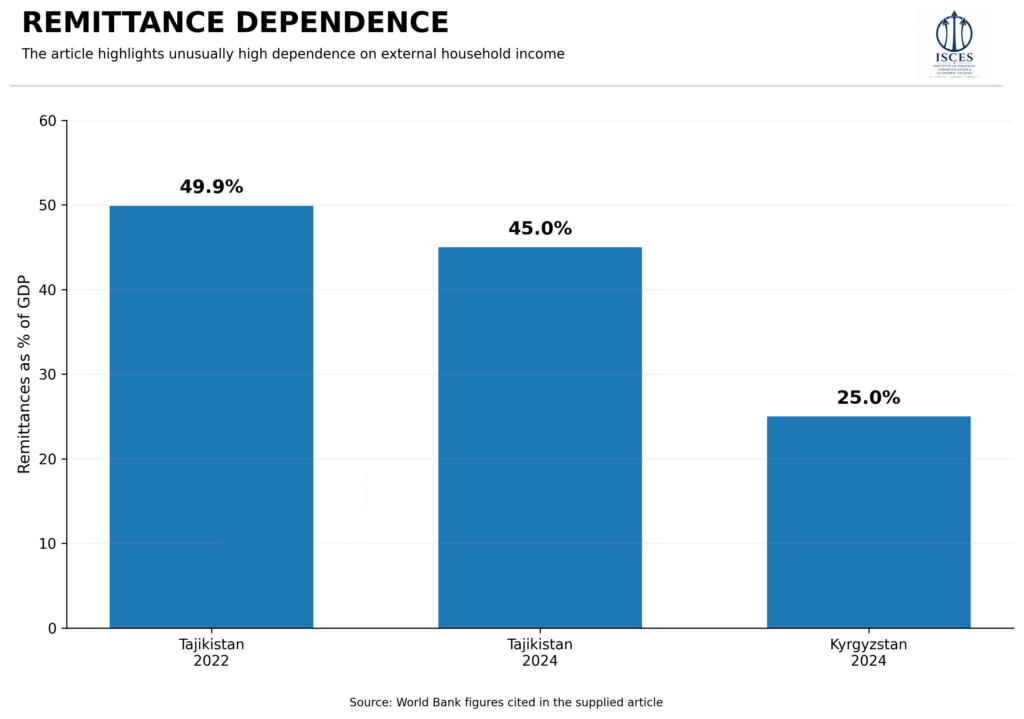
Kyrgyzstan and Tajikistan took a different route to growth: labor migration, overwhelmingly to Russia. Dependence is starkest in Tajikistan, where a 1992-1997 civil war was followed by political consolidation under Emomali Rahmon but limited domestic job creation. World Bank data show remittances reaching nearly half of Tajik GDP in recent years — 49.9 percent in 2022, still above 45 percent in 2024 — among the highest ratios recorded anywhere in the world. Kyrgyzstan, more politically volatile (it changed governments in 2005, 2010 and 2020), depends somewhat less on remittances, at roughly a quarter of GDP in 2024, alongside gold exports and a growing re-export and logistics sector tied to trade with Russia. In both countries, remittances have measurably reduced poverty, but they also expose households to shocks originating elsewhere — a Russian downturn, a change in migration policy, a fall in gold prices.
War, Wealth and What Became Visible
If Central Asia’s divergence was driven mainly by resources, geography and reform choices, the South Caucasus was shaped just as much by territorial conflict. Azerbaijan and Armenia became independent as the Nagorno-Karabakh dispute was escalating into war, and security dominated both countries’ development for three decades.
Azerbaijan combined oil wealth with sustained rearmament. Caspian hydrocarbon revenue, exported in part via the Baku-Tbilisi-Ceyhan pipeline that came online in 2005-06, funded both Baku’s urban development and a military buildup following Azerbaijan’s losses in the first Karabakh war of the 1990s. That investment paid off militarily: Azerbaijan won a decisive war in 2020, and in September 2023 it retook full control of Nagorno-Karabakh in a rapid military operation. Within roughly two weeks, more than 100,000 ethnic Armenians, nearly the entire population of the enclave, had fled to Armenia. Human rights investigators, including a Freedom House-backed fact-finding mission, have concluded that Azerbaijan’s campaign against the Karabakh Armenian population meets the international definition of ethnic cleansing; Baku disputes that characterization and says departures were voluntary. In 2025, Armenia and Azerbaijan reached a framework peace agreement, formally closing the most active phase of a conflict that had shaped both economies since 1991. Armenia’s story is the mirror image. For most of the post-Soviet period, Armenia treated Russia as its principal security guarantor. The 2020 war and the loss of Karabakh in 2023, during which
Russian peacekeepers stationed in the region did not intervene, forced a reassessment. Armenia has not broken with Moscow, but it has visibly diversified, deepening ties with the European Union, the United States, and, as of 2025, Pakistan. Georgia followed a third path. The 2003 Rose Revolution brought a government that pursued an unusually aggressive anti-corruption campaign: Georgia’s ranking on Transparency International’s Corruption Perceptions Index rose from 124th of 133 countries in 2003 to among the better-performing states in Eastern Europe within less than a decade. Lacking Azerbaijan’s oil or Kazakhstan’s minerals, Georgia built an economy on openness — tourism, transit, services and foreign investment — surviving even a brief war with Russia in August 2008. That model depends on outside confidence in Georgia’s predictability, which has come under strain since 2024: after Georgia’s parliament passed a “foreign agents” law modeled on Russian legislation, the European Union suspended Georgia’s accession process and froze defense assistance; the Georgian government later announced its own four-year pause of EU membership talks, triggering sustained protests in Tbilisi.
A Lens, Not a Verdict
The luxury retail visible in each capital — established boutiques in Almaty, newer malls in post-2016 Tashkent, marble state architecture in Ashgabat, Baku’s hydrocarbon-funded skyline, diaspora-financed property in Yerevan, tourism-driven real estate in Tbilisi — offers a rough visual index of how each economy generates wealth. But visible affluence is not evidence of broad-based development. What determines resilience is a narrower set of questions: how many people hold productive jobs, how fast real incomes are rising, and how exposed growth is to a shift in commodity prices or geopolitics.
PAKISTAN AND THE POST-SOVIET EIGHT
By the mid-2020s, the more consequential question for several of these states was not how far they had moved from Moscow, but where else they could go — and for the five Central Asian states in particular, one increasingly serious answer runs south through Afghanistan to Pakistan. Pakistan’s relationships with all eight countries have shifted noticeably in the past two to three years, though from very different starting points and at very different speeds.
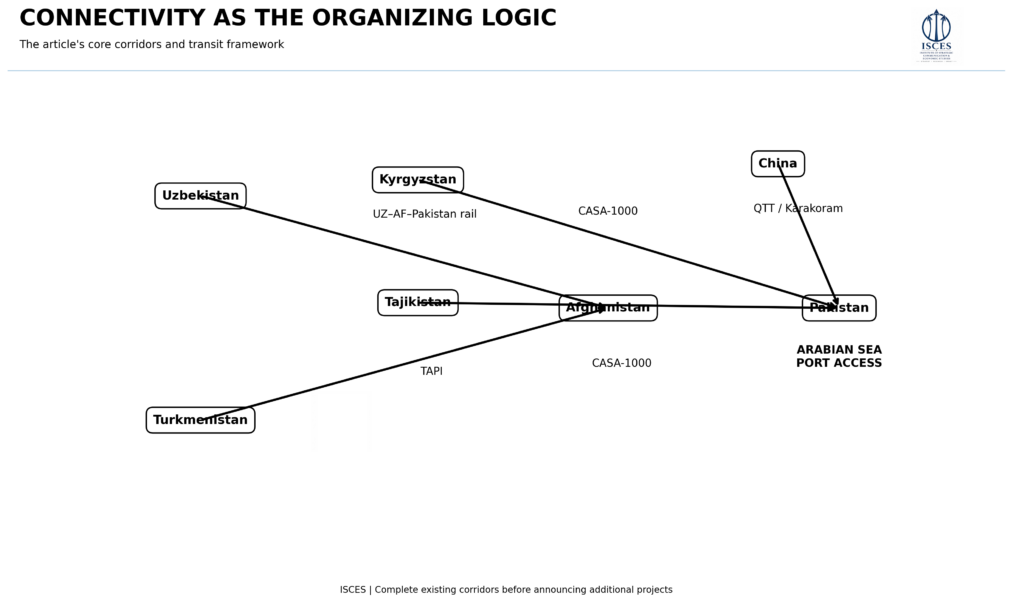
Central Asia: Connectivity as the Organizing Logic
Kazakhstan. Pakistan was among the earliest states to recognize Kazakhstan’s independence, in December 1991, with formal diplomatic relations following in February 1992. For most of the following three decades, the relationship stayed thin. That changed in February 2026, when Kazakh President Kassym-Jomart Tokayev’s state visit to Islamabad produced more than 30 memoranda of understanding and an upgrade to a formal strategic partnership, alongside a roadmap targeting $1 billion in annual trade a goal that implies roughly a tenfold increase from the $105.6 million recorded in the first eleven months of 2025. Landlocked Kazakhstan’s core interest is straightforward: reliable access to Pakistan’s Arabian Sea ports, and a hedge against relying solely on Russian-controlled export routes.
Uzbekistan. This is Pakistan’s most developed Central Asian relationship. A 2021 Transit Trade Agreement and a 2022 Preferential Trade Agreement covering 17 product categories, in force since 2023, helped push bilateral trade past $400 million in 2024 and toward roughly $450 million in 2025, making Uzbekistan Pakistan’s largest Central Asian trading partner, with about 130 joint ventures and nearly 2,000 Pakistani students enrolled in Uzbek universities. Both governments have set a $2 billion target within several years. The relationship’s centerpiece is the Uzbekistan-Afghanistan-Pakistan railway framework agreement signed in July 2025, which is the clearest test of whether Uzbekistan’s search for sea access becomes operational rather than aspirational.
Turkmenistan. This relationship runs almost entirely through the TAPI pipeline. Pakistani governments have signed successive implementation accords, most recently in 2025, to expedite construction, and officials on both sides have floated a bilateral trade target of $4 billion, aspirational, since current trade volumes are modest. Islamabad has also proposed Gwadar as an export outlet for Turkmen hydrocarbons, though this depends entirely on the pipeline’s unbuilt Afghan and Pakistani sections.
Kyrgyzstan. This is the thinnest relationship among the five Central Asian states in commercial terms: annual trade has fluctuated below $10 million, and Kyrgyzstan’s president made his first visit to Pakistan in twenty years only in December 2025, when both sides agreed to pursue a long-delayed transit trade agreement targeting $100 million — itself roughly a tenfold increase from current levels. CASA-1000 is the more consequential link, since it is a joint Kyrgyz-Tajik-Afghan-Pakistani project whose completion, expected around 2026-27, would likely do more for the relationship than any trade target.
Tajikistan. Tajikistan shares CASA-1000 with Kyrgyzstan and has separately signed a Transit Trade Agreement with Pakistan along with memoranda on counter-narcotics cooperation, education, and customs data exchange. Islamabad has backed Tajikistan’s 2017 request to join the Quadrilateral Transit Trade Agreement, a framework currently limited to Pakistan, China, Kazakhstan and Kyrgyzstan, which would give Dushanbe a documented route to Pakistani ports via the Karakoram Highway — an alternative that gained renewed relevance as instability on the Pakistan-Afghanistan border repeatedly disrupted the traditional transit corridor through 2025 and 2026.
South Caucasus: Politics Ahead of Economics
Azerbaijan. This is the outlier of the eight, and by far the closest relationship Pakistan maintains with any of them. Formal ties date to 1992, but the relationship is anchored less in trade than in a shared political position: Pakistan backed Azerbaijan diplomatically throughout the Nagorno-Karabakh conflict, including during the 2020 war, and was for decades the only major state that declined to recognize Armenia, largely because of that alignment. A 2002 defense cooperation agreement has grown into joint military exercises with Turkey, Pakistani arms sales including JF-17 fighter jets, and, following President Ilham Aliyev’s 2024 visit to Islamabad, fifteen new memoranda of understanding and a stated ambition to raise bilateral trade to $2 billion. Pakistani officials have described the relationship in explicitly fraternal terms; Prime Minister Shehbaz Sharif has called the two countries “two hearts in one body,” language considerably warmer than Pakistan uses for any other state examined here.
Armenia. This is the newest relationship in the entire group. Until August 2025, Pakistan was the only UN member state without diplomatic relations with Armenia, a position tied directly to its alignment with Azerbaijan. That changed on August 31, 2025, when the two countries’ foreign ministers signed a joint communiqué establishing formal ties on the sidelines of the Shanghai Cooperation Organisation summit in Tianjin, a direct consequence of the Armenia-Azerbaijan peace framework reached earlier that year. Economic ties remain minimal, and no trade or transit agreements yet exist; the opening is diplomatically significant but commercially undeveloped.
Georgia. This is the least developed of the eight relationships by almost any measure. Diplomatic relations were established in 1994 but have seen little follow-through since. The two countries maintain a visa exemption agreement, in force since 2024, but it covers only diplomatic and official passport holders. Bilateral trade turnover was recorded at roughly $1.5 million over two months in early 2024 — a figure that, even generously annualized, would make Georgia one of Pakistan’s smallest trading partners worldwide. Pakistan’s ambassador to Azerbaijan holds a concurrent, non-resident accreditation to Georgia, itself a reasonable indicator of how little diplomatic priority Islamabad has assigned the relationship.
Areas of Cooperation and How to Improve Relations
Four patterns cut across all eight relationships, and each points toward a specific, achievable next step rather than a further round of high-level declarations.
Complete what is already underway before adding new projects. The Trans-Afghan Railway framework, CASA-1000 and TAPI are not separate initiatives but three legs of the same underlying bet: that a stable southern corridor through Afghanistan can substitute for routes that currently run through Russia. Pakistan’s own construction record on CASA-1000 — its transmission towers were more than 80 percent complete by mid-2024 — is a genuine credibility asset. Islamabad’s most useful move is to press Afghanistan and the project’s international financiers on the remaining, unfinished Afghan sections of these three projects, rather than announcing further connectivity concepts.
Convert trade targets into expanded product coverage. Every Central Asian target examined here is aspirational relative to current volumes: Kazakhstan’s $1 billion goal against roughly $105 million in recent trade, Turkmenistan’s $4 billion goal against a modest undisclosed base, Kyrgyzstan’s $100 million goal against under $10 million. Announcing bigger targets has not, on its own, moved the underlying trade figures. Uzbekistan’s Preferential Trade Agreement, still limited to 17 product categories after three years in force, illustrates the more concrete alternative: widening existing agreements’ product coverage is likely to do more than setting new round-number goals.
Finish accession to the transit framework that already exists. The Quadrilateral Transit Trade Agreement, currently limited to Pakistan, China, Kazakhstan and Kyrgyzstan, is the most underused instrument already on the table. Tajikistan requested membership in 2017 and Uzbekistan in 2020; neither accession has been finalized. Completing them would give Pakistan a documented alternative route to four Central Asian states that does not depend on Afghan stability, a real vulnerability, given that disruptions to the Afghan transit corridor have, by one regional economist’s estimate, cost as much as $177 million in a single month of closures.
Handle the South Caucasus with more care than momentum. Pakistan’s depth of alignment with Azerbaijan is a genuine asset, but it also constrains how quickly the other two relationships can develop, and both require deliberate, low-risk steps rather than drift. The Armenia opening is recent and fragile; building it out even modestly, through education or tourism arrangements rather than anything touching security, would demonstrate that 2025’s recognition reflects a durable shift in Pakistani policy rather than a formality extracted by the Armenia-Azerbaijan peace process. Georgia, by contrast, has simply never been treated as a priority; appointing a resident ambassador rather than continuing with a non-resident accreditation from Baku would be a low-cost step that could unlock a relationship starting from an unusually low base.
Conclusion
The eight successor states examined here are not usefully described as winners or losers of the post-Soviet transition, and Pakistan’s relationships with them cannot be usefully ranked on a single scale either. Each carries a different unfinished economic problem concentrated wealth, a landlocked geography, remittance dependence, unresolved displacement, or institutional fragility and Pakistan’s ties to each are shaped by a different mix of geography, energy need, and political alignment: deep and long-standing with Azerbaijan, rapidly commercial with Uzbekistan and increasingly Kazakhstan, thin but growing with Kyrgyzstan and Tajikistan, aspirational with Turkmenistan, newly opened with Armenia, and largely dormant with Georgia. Whether new southern corridors through Afghanistan to Pakistan become a genuine option for the Central Asian states, and whether Pakistan follows its 2025 opening to Armenia and its dormant tie to Georgia with real investment, will do more to shape the next decade of these relationships than any further distance traveled from Moscow.
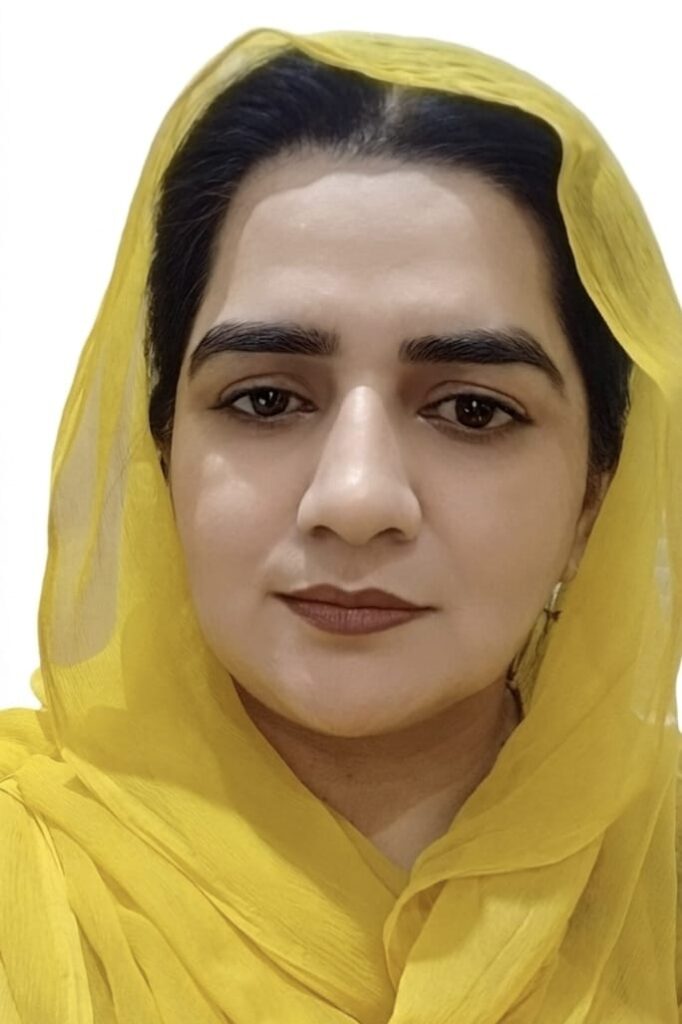
Dr. Mahnaz Muhammad Ali is an Associate Professor of Economics at The Islamia University of Bahawalpur, Pakistan, with over 18 years of experience in teaching, research, and academic scholarship. Her areas of expertise include international economics, public economics, economic policy, and development-related issues. She holds a PhD in Economics and has published extensively in national and international journals.
Miss Farzeen Shaukat is a Gold Medalist in Economics and Finance with professional experience in management, finance, and accounting. She is a researcher and an economist who often contributes to different periodicals.