
By Falak Sher Khan
The Geopolitical Dividend of Electrification:
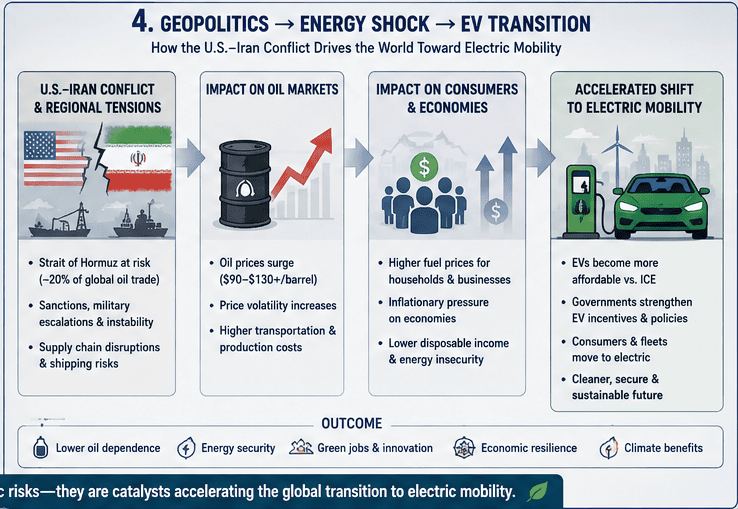
The recent military confrontation between the United States and Iran has once again underscored a structural vulnerability in the global economy: the continued dependence of transportation, manufacturing, and international trade on petroleum. While the immediate consequences of geopolitical instability are reflected in elevated crude oil prices, increased shipping costs, inflationary pressures, and financial market volatility, the longer-term economic implications may prove even more transformative. Chief among them is the accelerated global transition toward electric mobility.
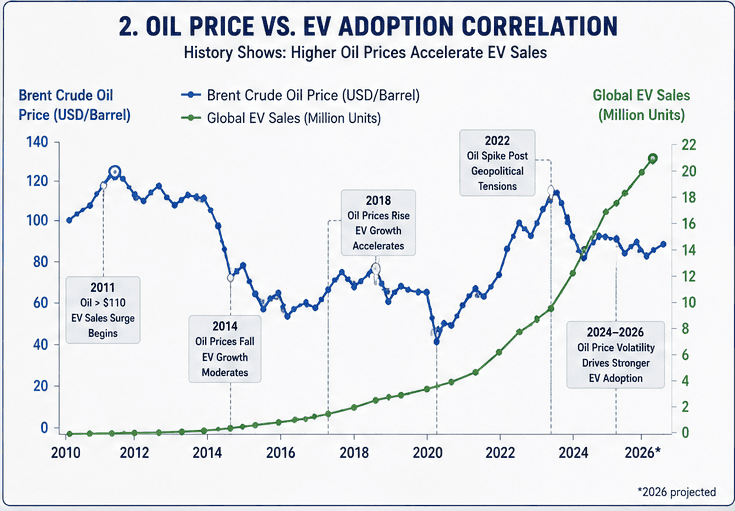
History demonstrates that every major oil shock—from the 1973 Arab Oil Embargo and the 1979 Iranian Revolution to the Gulf Wars and the Russia–Ukraine conflict—has reshaped energy policy, industrial investment, and technological innovation. The latest U.S.–Iran confrontation is likely to reinforce this historical pattern. As governments seek to reduce strategic dependence on imported hydrocarbons and consumers respond to persistently higher fuel costs, electric vehicles (EVs) are increasingly being viewed not only as environmentally preferable alternatives but as strategic economic assets capable of strengthening national energy security and industrial resilience.
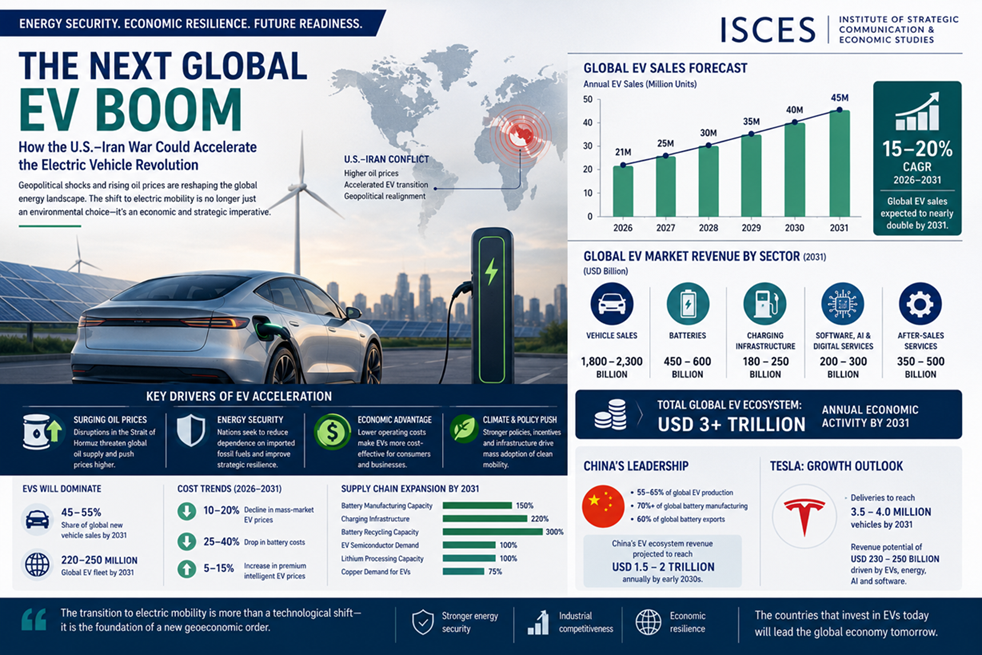
Over the next five years, the global EV industry is expected to experience one of the fastest periods of expansion in modern automotive history. Annual EV sales are projected to nearly double, the global electric mobility ecosystem is expected to exceed US$3 trillion in annual economic value, and investment across battery manufacturing, charging infrastructure, critical minerals, software, and after-sales services is likely to redefine global industrial competition.
Geopolitical Risk as a Catalyst for Structural Energy Transition
The strategic significance of the Strait of Hormuz cannot be overstated. Approximately one-fifth of globally traded crude oil passes through this maritime corridor, making any disruption an immediate concern for global energy markets. The recent conflict has highlighted the fragility of oil-dependent economies and the substantial economic costs associated with supply disruptions.
Sustained increases in petroleum prices alter the economics of vehicle ownership. As gasoline and diesel prices rise, the total cost of ownership of electric vehicles becomes increasingly attractive, shortening payback periods for consumers and commercial fleet operators alike. Simultaneously, governments become more inclined to accelerate electrification through fiscal incentives, infrastructure investment, and industrial policy designed to reduce exposure to volatile international oil markets.
Consequently, geopolitical instability has become an unexpected accelerator of the global clean mobility transition.
The Next Five Years: A Decade of Accelerated EV Adoption
Industry forecasts indicate that the coming five years will witness unprecedented growth in global electric vehicle deployment.
Annual global EV sales are expected to rise from approximately 21 million vehicles in 2026 to nearly 45 million units by 2031, representing a compound annual growth rate of roughly 15–20 percent.
During the same period:
- Electric vehicles are expected to account for 45–55 percent of all new passenger vehicle sales globally.
- The worldwide EV fleet is projected to expand from approximately 95 million vehicles to between 220 and 250 million vehicles.
- Commercial fleets, ride-hailing operators, logistics companies, and public transport systems are expected to become major drivers of electrification.
This expansion will not be confined to developed economies. Emerging markets across Asia, Latin America, the Middle East, and Africa are expected to contribute a growing proportion of future EV demand as manufacturing costs decline and charging infrastructure expands.
Market Economics: Declining Costs, Rising Value
Contrary to conventional assumptions, the next generation of electric vehicles is expected to become progressively more affordable.
Mass-market EV prices are projected to decline by 10–20 percent over the next five years as manufacturers benefit from economies of scale, localized supply chains, and falling battery costs.
Battery prices—the single largest component of EV manufacturing—are forecast to decrease by 25–40 percent, further narrowing the price gap with internal combustion engine vehicles.
Conversely, premium EVs equipped with autonomous driving capabilities, artificial intelligence, advanced software ecosystems, and ultra-fast charging technologies are expected to command premium pricing, increasing by approximately 5–15 percent as consumers place greater value on intelligent mobility rather than mechanical engineering alone.
This divergence signals a broader transformation in the automotive industry, where software increasingly becomes as valuable as hardware.
The Emerging Trillion-Dollar Supply Chain
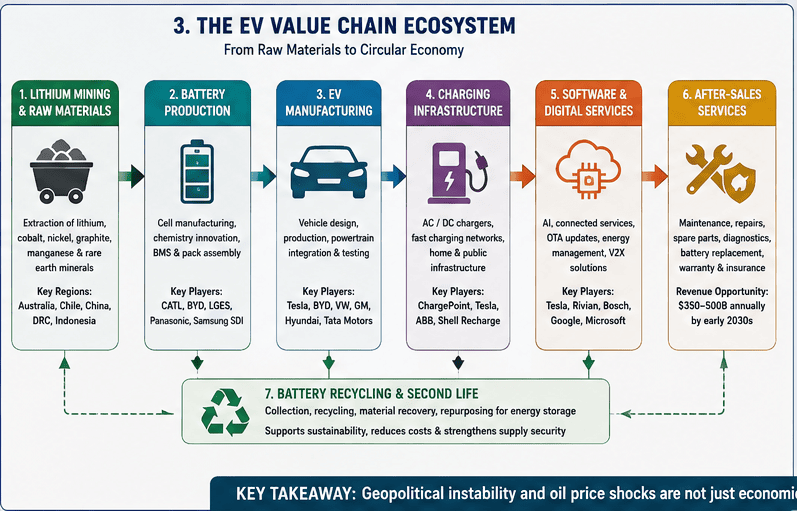
The most profound economic opportunity lies not merely in vehicle production but across the broader electric mobility value chain.
By 2031, global manufacturing capacity is expected to expand substantially:
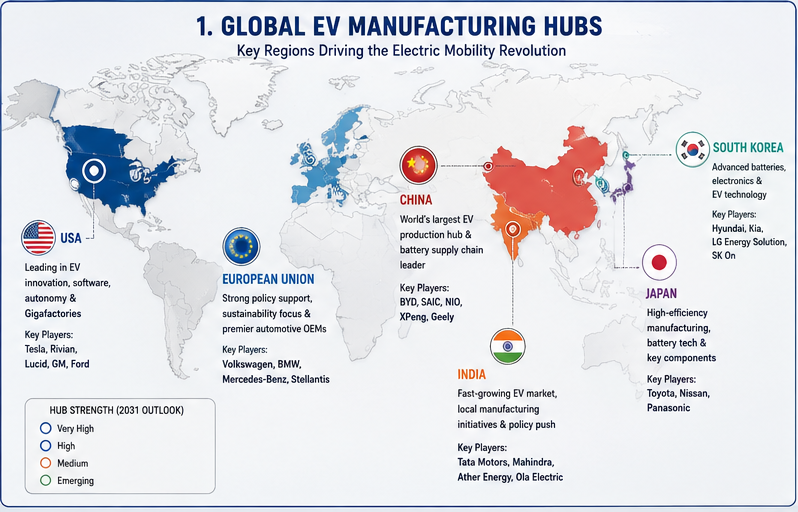
- Battery manufacturing capacity: 120–170 percent increase
- Public charging infrastructure: 180–250 percent increase
- Battery recycling capacity: approximately 300 percent increase
- EV semiconductor demand: 80–120 percent increase
- Lithium refining capacity: approximately 100 percent increase
- Copper demand associated with EV production: 60–90 percent increase
These industries collectively represent one of the largest industrial investment cycles since the digital revolution.
Countries capable of controlling these supply chains will possess significant strategic advantages in future manufacturing competitiveness.
China’s Strategic Advantage
China has already established itself as the undisputed leader of the global electric vehicle ecosystem.
By the early 2030s, Chinese manufacturers are expected to account for:
- 55–65 percent of global EV production
- More than 70 percent of worldwide lithium-ion battery manufacturing
- Nearly 60 percent of global battery exports
Companies such as BYD, SAIC, Geely, Chery, XPeng, NIO, and Li Auto are rapidly expanding across Europe, Southeast Asia, Latin America, the Middle East, and Africa, supported by vertically integrated supply chains and substantial government investment.
The combined annual value generated by China’s EV ecosystem—including vehicles, batteries, charging infrastructure, software platforms, battery recycling, and mobility services—is projected to exceed US$1.5–2 trillion, making it one of the most strategically important industrial sectors in the global economy.
The Global EV Economy: Beyond Vehicle Manufacturing
The electric mobility revolution extends far beyond automobile production.
By 2031, annual global revenues are expected to reach:
| Sector | Estimated Annual Revenue |
| Electric Vehicle Manufacturing | US$1.8–2.3 trillion |
| Battery Production | US$450–600 billion |
| Charging Infrastructure | US$180–250 billion |
| Software, AI & Digital Services | US$200–300 billion |
| After-Sales Services | US$350–500 billion |
Collectively, these industries are expected to generate well above US$3 trillion annually, positioning electric mobility among the world’s largest industrial ecosystems.
After-Sales Services: The Quiet Economic Giant
One of the least appreciated dimensions of the EV revolution is the emergence of an entirely new after-sales economy.
Unlike conventional automobiles, electric vehicles increasingly rely upon continuous software upgrades, predictive diagnostics, battery health monitoring, cloud connectivity, cybersecurity, autonomous driving enhancements, and digital subscription services.
The future after-sales ecosystem will encompass:
- AI-assisted predictive maintenance
- Remote diagnostics
- Battery refurbishment and replacement
- Charging subscriptions
- Fleet management software
- Battery recycling
- Vehicle software licensing
This segment alone could exceed US$350–500 billion annually, offering substantially higher profit margins than traditional automotive servicing.
Tesla: From Automotive Manufacturer to Technology Platform
Although competition has intensified, Tesla remains one of the most influential companies shaping the electric mobility landscape.
Rather than competing solely as an automobile manufacturer, Tesla increasingly operates as an integrated technology company spanning artificial intelligence, autonomous driving, robotics, battery storage, cloud software, and distributed energy systems.
Current projections suggest Tesla’s annual vehicle deliveries could increase from approximately 2.2 million vehicles in 2026 to between 3.5 and 4.0 million vehicles by 2031, while annual revenues may exceed US$230–250 billion, assuming continued expansion across energy storage, autonomous mobility, and AI-driven services.
Its relative share of the global EV market may gradually decline—not because demand weakens, but because the overall market is expanding even faster as new competitors enter the industry.
Strategic Implications for Governments and Emerging Economies
The economic lessons arising from the U.S.–Iran conflict extend well beyond the Middle East.
The defining competition of the coming decade will not simply concern access to oil reserves but control over batteries, semiconductors, artificial intelligence, charging infrastructure, critical minerals, and advanced manufacturing.
Countries that successfully develop domestic EV ecosystems will enjoy multiple strategic benefits:
- Reduced dependence on imported petroleum
- Enhanced energy security
- Lower transportation costs
- Greater industrial competitiveness
- Higher value-added manufacturing
- Expanded employment opportunities
- Improved trade balances
- Leadership in emerging technologies
For emerging economies such as Pakistan, this transition presents a strategic opportunity. By investing in EV assembly, battery recycling, charging infrastructure, vocational skills, software development, and critical-mineral value addition, countries can position themselves in one of the fastest-growing industrial sectors of the twenty-first century.
Conclusion: Electrification as the New Geoeconomic Order
The recent U.S.–Iran conflict should not be viewed solely through the lens of military confrontation or energy market disruption. Rather, it represents another pivotal moment in the gradual transformation of the global economic order.
Higher oil prices are accelerating consumer demand for electric mobility, encouraging governments to pursue greater energy independence, and stimulating unprecedented investment across the EV value chain. Over the next five years, annual EV sales are expected to approximately double, the global electric mobility ecosystem is projected to surpass US$3 trillion in annual economic value, and China is likely to consolidate its industrial leadership while companies such as Tesla evolve into diversified technology platforms.
The transition underway is therefore much larger than a shift from internal combustion engines to electric drivetrains. It marks the emergence of a new geoeconomic paradigm in which technological capability, industrial resilience, and control over clean energy supply chains will increasingly determine national prosperity and geopolitical influence.
The countries that recognize this transformation today—and invest accordingly—will shape the future architecture of global transportation, manufacturing, and economic power.