
By Mian Majid Ali Afzal
Understanding the Concept of Accountability
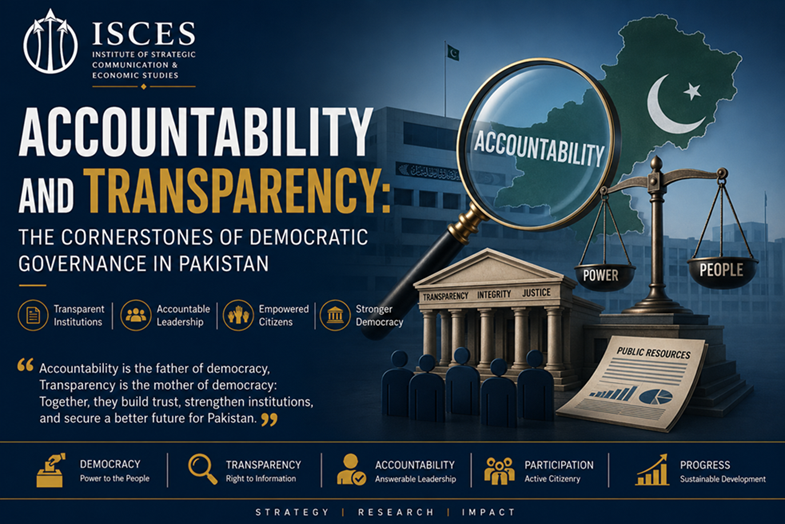
Accountability is the father of democracy, while transparency is its mother. Together, they form the foundation of democratic governance and good public administration. Unfortunately, Pakistan has long struggled to institutionalize both transparency and accountability, leaving democratic institutions vulnerable to inefficiency, corruption, and declining public trust. Although accountability is frequently discussed in political discourse, there is no universally accepted definition. It is a multidimensional concept that extends beyond punishment or blame and encompasses responsibility, answerability, transparency, responsiveness, and institutional integrity.
Accountability has several dimensions. For some, it simply means accountability for outcomes. Governments are expected to deliver quality education, accessible healthcare, economic growth, public safety, and improved living standards. Citizens therefore hold governments accountable for achieving these outcomes.
Another dimension of accountability concerns the quality of institutions. Democratic institutions should ideally be transparent, efficient, responsive, and representative. However, these characteristics do not always coexist. A representative government may not necessarily be responsive to citizens’ needs, while transparent institutions may still suffer from inefficiency. Likewise, an institution may be responsive but unable to produce the desired outcomes due to structural limitations. Therefore, accountability should not be viewed merely as transparency or punishment; rather, it is a comprehensive framework for ensuring responsible governance.
Accountability as the Foundation of Democracy
Accountability is central to the deepening of democracy. Democracy is not merely a political system but a system of governance in which citizens exercise control over public authority. The effectiveness of this control determines the quality of democracy.
A healthy democratic system maintains a balance between executive authority and institutional oversight. More importantly, democracy depends upon strong and trustworthy relationships between citizens and the state. Public confidence grows only when institutions consistently demonstrate fairness, transparency, and responsiveness.
Beyond Elections: Democratic Accountability in Everyday Governance
Democracy should not be confined to elections held every four or five years. While free and fair elections remain essential, democratic accountability must continue throughout the entire electoral cycle.
Governments should remain accountable through independent media, parliamentary oversight, judicial review, civil society organizations, and active citizen participation. Citizens must have opportunities to question public decisions, organize peacefully, express their opinions freely, and participate in policymaking. These mechanisms ensure that democracy remains a continuous process rather than a periodic political event.
Transparency: The First Step Towards Accountability
Transparency begins with access to information. Citizens have the right to know how governments formulate policies, spend public resources, implement development projects, and make administrative decisions.
However, transparency alone does not guarantee accountability. Information must be accompanied by clear mechanisms for identifying responsibility, investigating failures, correcting mistakes, and preventing future misconduct. For instance, allegations of electoral malpractice should not only be exposed but also investigated independently, with those responsible held accountable under the law.
In practice, accountability means that every citizen has the right to information, dignity, participation, and justice. Citizens are entitled to know how national resources are utilized, what plans governments have for future development, and whether public institutions are fulfilling their constitutional obligations.
Likewise, governments have a responsibility to protect citizens’ rights, ensure public safety, and provide essential services efficiently. Accountability therefore operates as a two-way relationship between the state and its citizens.
Strengthening Institutions for Good Governance
Over the past two decades, Pakistan has established several regulatory institutions to improve governance across different sectors. These institutions represent an important step toward modern public administration.
However, creating institutions alone is insufficient. Regulatory bodies themselves must be transparent, independent, professionally managed, and subject to effective oversight. Accountability should extend beyond government ministries to include regulatory authorities, public corporations, the private sector, and the media, ensuring that every institution exercises power responsibly.
Political Party Reforms and Parliamentary Accountability
Political parties are the primary vehicles through which democratic representation operates. Consequently, internal party democracy is essential for strengthening accountability.
Transparent candidate selection, democratic leadership elections, policy-based decision-making, and merit-based governance can significantly improve political accountability. At the same time, electoral reforms should enable voters to evaluate the performance of individual legislators rather than merely political parties.
Pakistan’s anti-defection laws have strengthened party discipline but have also reduced the independence of Members of Parliament. While these laws discourage political instability and horse-trading, they also limit legislators’ ability to exercise independent judgment. Future reforms should seek an appropriate balance between party cohesion and individual accountability.
Institutionalizing Accountability Across Society
Accountability should not be limited to elected governments alone. Every institution exercising public influence—including the judiciary, bureaucracy, corporate sector, media organizations, and civil society—must operate within transparent and accountable frameworks.
Institutionalizing accountability requires independent oversight bodies, effective audit systems, freedom of information laws, professional public administration, and strong parliamentary committees. Sustainable democratic governance depends upon institutions rather than individuals.
Modern democracies increasingly rely upon informed and active citizens. Young people have become important stakeholders in promoting accountability through civic engagement, digital participation, and policy advocacy.
Technology and social media have transformed governance by enabling governments to communicate directly with citizens while allowing the public to monitor governmental performance in real time. However, digital platforms should encourage informed dialogue and constructive engagement rather than misinformation or political polarization.
Building Public Trust Through Accountability
Public trust is one of the most valuable assets of any democratic system. Transparency and accountability strengthen this trust by ensuring that institutions remain answerable to the people and committed to the public interest.
When governments are transparent, citizens develop greater confidence in public institutions. When accountability mechanisms function effectively, corruption decreases, governance improves, and democratic legitimacy is strengthened. Ultimately, accountability promotes political stability, economic development, and social cohesion.
The Way Forward for Pakistan
Pakistan possesses the institutional capacity and human potential to strengthen democratic governance through meaningful reforms. Achieving this objective requires political commitment, institutional independence, transparent public administration, judicial impartiality, electoral reforms, responsible media, and active citizen participation.
The responsibility for strengthening democracy does not rest solely with governments. Citizens must also contribute through informed voting, constructive public engagement, lawful protest, community participation, and policy dialogue. Democratic accountability is most effective when both governments and citizens recognize their shared responsibilities.
Conclusion
Accountability and transparency are indispensable pillars of democratic governance. Together, they ensure that governments remain answerable to the people, institutions operate fairly and efficiently, and public resources are managed responsibly.
For Pakistan, strengthening accountability requires more than legal reforms. It demands institutional integrity, democratic political parties, independent oversight mechanisms, responsible leadership, and an informed and engaged citizenry. By embracing these principles, Pakistan can build stronger democratic institutions, restore public trust, promote good governance, and lay the foundation for sustainable national development. Accountability is not merely about exposing failures; it is about creating institutions that learn, improve, and consistently serve the public interest. Only through transparency, accountability, and collective responsibility can Pakistan realize the full promise of a stable, prosperous, and resilient democracy.