By Aamir Zulfiqar Khan, IGP Police
On 20th December, 2025, the Deputy Prime Minister/Foreign Minister of Pakistan briefed the Diplomatic Corps in Islamabad on India’s persistent material breaches of the Indus Waters Treaty (IWT). He highlighted India’s repeated manipulation of water flows, construction of illegal hydropower projects on the Western Rivers, and refusal to engage the IWT’s dispute-resolution mechanisms.
Thus, Pakistan has timely placed its case in front of the International community and has re-emphasised the dangers inherent in this bellicose and illegal Indian weaponisation of water.
Unfortunately, history tells us that it has always been India’s desire to stop/regulate waters of the Indus basin from flowing into Pakistan. Despite well-established International Laws, governing the water flow between the upper and lower riparians, India first stopped water flow to Pakistan on April 1, 1948, shortly after Partition, by shutting off key canals like the Upper Bari Doab and Dipalpur Canals.
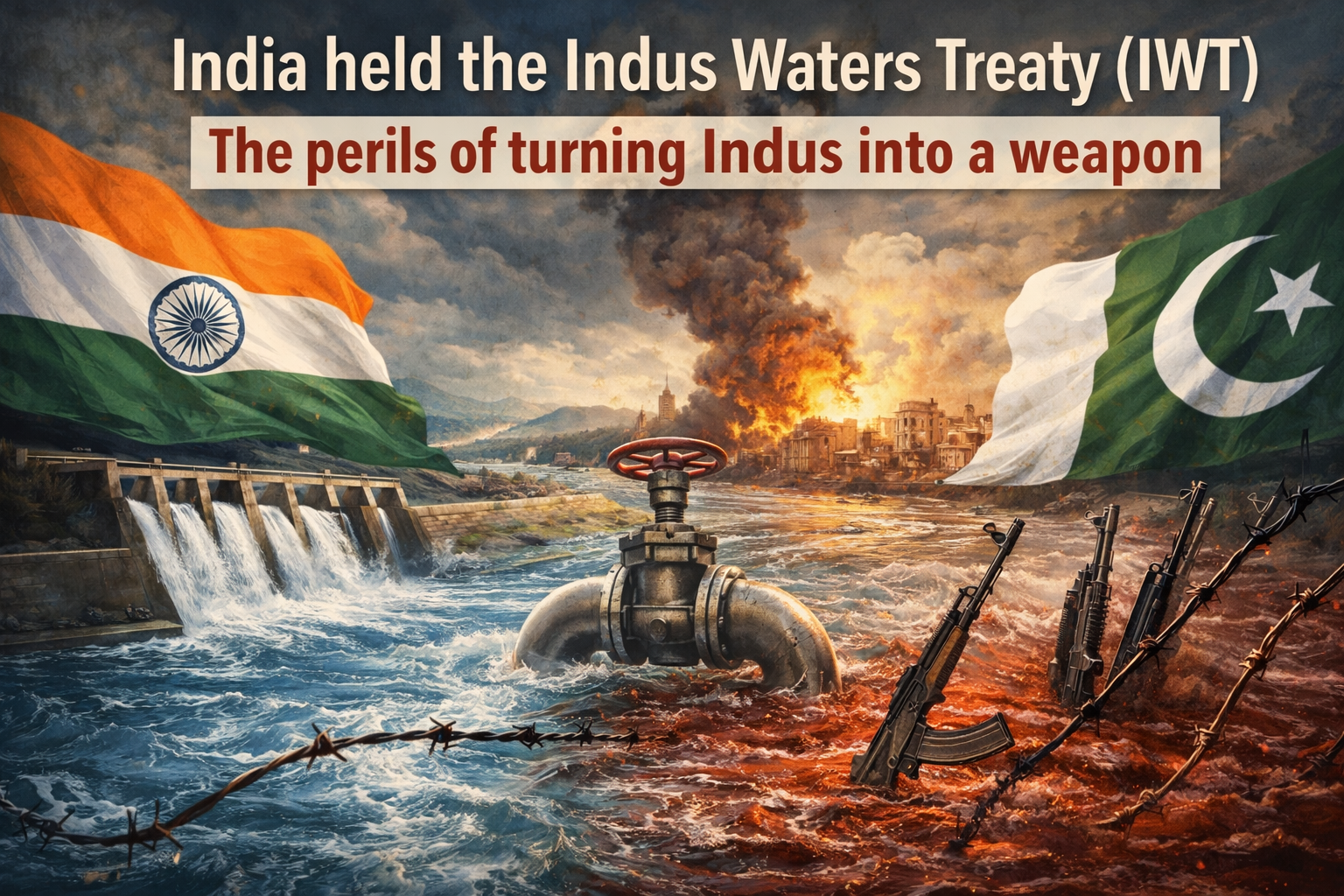
This led to negotiations and after 12 years, the World Bank brokered the Indus Water Treaty in 1960, between the two Countries. And despite Wars and continuous acrimony between them, IWT was held sacrosanct by both. However, India held the Indus Waters Treaty (IWT) in abeyance starting April 23, 2025, immediately following the Pahalgam terror attack. Sadly, without an iota of evidence, India’s Foreign Secretary announced the move as a response to perceived cross-border terrorism. This was an illegal step as the IWT itself has no provision for unilateral suspension under international law, leading to legal challenges from Pakistan.
Since, then India is using its upstream position to create uncertainty, fear and cause severe economic harm in Pakistan. Pakistan has been raising serious concerns on the hydropower projects on the western rivers (Indus, Jhelum and Chenab) especially Baglihar, Kishanganga and Ratle, since the designs incorporate features which allow India to manipulate timing and volume of flows.
Moreover, “Blood and water cannot flow together” is a powerful phrase used by the Indian leadership, especially PM Narendra Modi, to signal a major shift in policy regarding the Indus Waters Treaty with Pakistan, meaning terrorism and diplomatic/resource-sharing relations cannot coexist. Thus, they have linked water flow to Pakistan’s alleged support for terrorism and threatening to halt water sharing in response to attacks. The phrase signifies that India will no longer allow water cooperation (the “water”) while it perceives ongoing “blood” spilled through terrorism, putting the treaty in abeyance and exploring maximizing its water rights under the pact.
Pakistan is already among the top most water stressed countries on the planet. Its per capita water availability, for a host of reasons, has sharply declined. Its economy and population remain heavily dependent on irrigated agriculture as approx. 80% of the farmland relies on the Indus system. Experts argue that cumulative impact of multiple dams combined with severe climatic variability, could give India a de facto control over seasonal flows, especially during the crucial sowing periods in Pakistan, thus creating an existential threat to the Country.
In order to explain to my respected readers, what is currently happening, I am placing the case of the river flows manipulation of the Chenab river. According to daily reports of WAPDA, the situation related to inflows and outflows at Marala headworks was found to be alarming from December 9-18. The inflows and outflows at Marala were monitored on the said dates with 10,100 and 3,800 cusecs on December 9, respectively, 6,900 and 1,500 cusecs on December 10. No outflows were monitored from Dec. 11-17.
The costs of the latest volatility in Chenab flows — just like the flow variations between late April and May — have been significant for farmers whose canal irrigation supplies were disrupted at a critical stage in the wheat season. Millions of acres of land across Punjab have faced reduced or zero water availability, threatening crop yields. This is how uncertainty — because of sudden releases and reductions and delayed data-sharing — changes water into a deadly tool. We need to remember that when India released floodwaters into the Ravi and Chenab in the summer, without the timely exchange of information or warning, it led to devastation in Punjab.
If the relations between India and Pakistan are to achieve a semblance of normalcy, implementation of IWT is the first concrete manifestation. And in order to ensure that it continues as a beacon of trust and future cordial relations, both countries and more so India have to take the following steps:
Firstly, India has to ensure enhanced transparency. Real time data sharing on flows, reservoir levels and dam operations could reduce suspicions.
Secondly, joint studies with mutually acceptable respected international experts on climate impacts and adaptive management could have a very positive impact without reopening core allocations
Thirdly, strengthening the role of neutral experts and insulating IWT from different crises may preserve cooperation.
Fourthly, cessation of sloganeering and inflammatory language from the Indian side could prevent escalation
Lastly, India needs to take back its abeyance of the treaty and accept the rights of Pakistan as per IWT and international laws between water sharing States.
It is to be remembered that on 24th April, 2025, Pakistan’s NSC stated that any attempt by India to block or divert water belonging to Pakistan would be considered an “act of war” and would be met with “full force across the complete spectrum of national power”. If after such a clear, unambiguous and powerful message by Pakistan, India still chooses to weaponize Indus basin water, then the entire onus is on India.
In the final analysis, the danger of a calamity lies less in water flow than in the erosion of trust. Water flows, not recognizing any man made border. In South Asia, which has nearly 1.7 billion people, who depend on the same melting glaciers and flowing rivers, turning water into a weapon- real or rhetorical- is the most dangerous gamble of all, not only for the two nuclear armed Countries but for the entire world.
It is still not too late. The world needs to wake-up and get this matter resolved at the earliest.

The writer has served as Inspector General of Police, Punjab, Islamabad, and National Highway and Motorways Police, and as DDG ANF Pakistan. He is a senior public policy expert with deep insight into conflict resolution and regional affairs. He can be reached at amzkhan.lhr@gmail.com