By Aamir Zulfiqar Khan, IGP Police
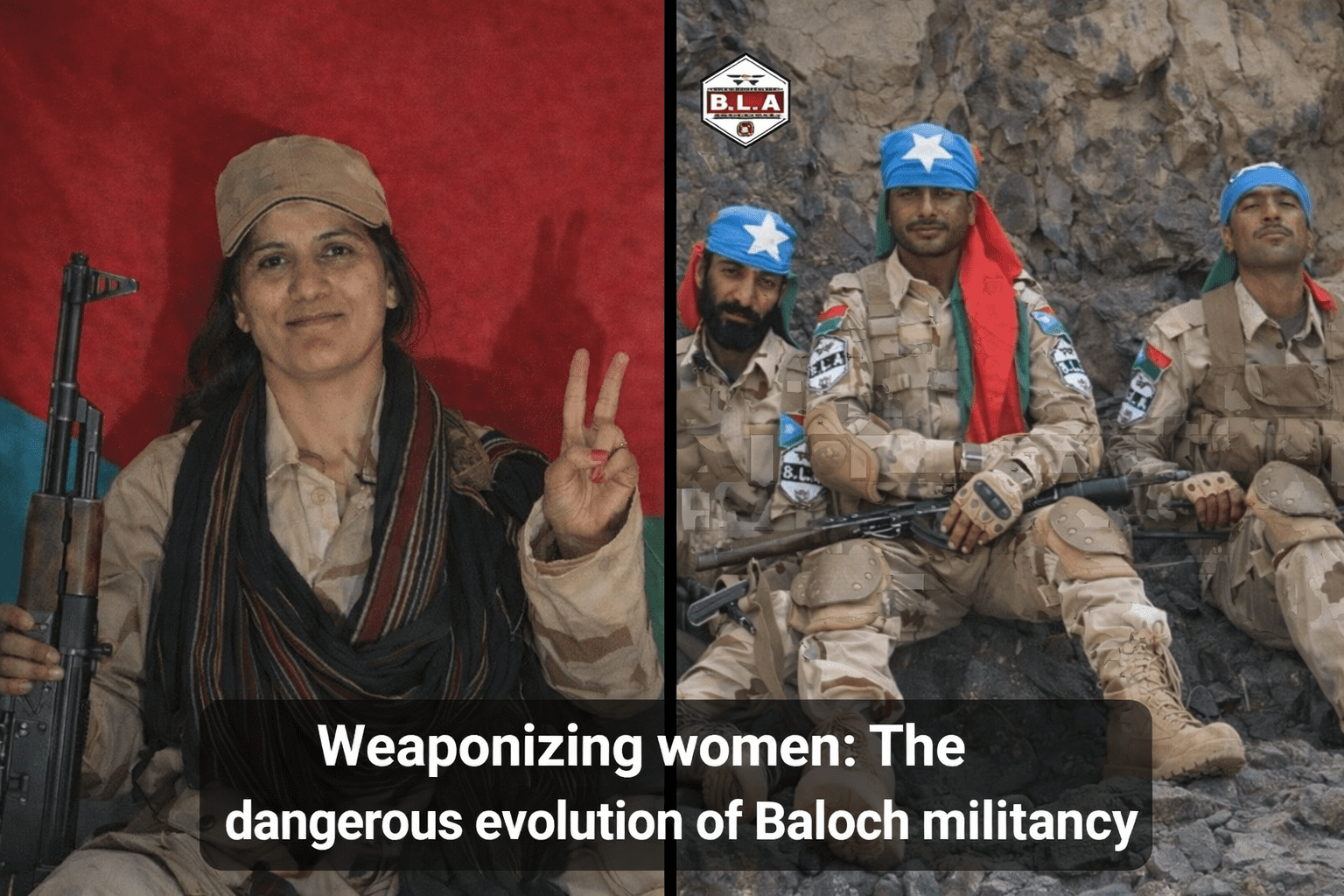
It was 2.45 pm on 26th April, 2022. Breaking News started flashing on TV screens. And then it was there. The first woman suicide bomber had exploded in Karachi. The incident took place near the Confucius Institute at the University of Karachi, where she detonated explosives as a van carrying Chinese academics approached the entrance. The attack, which killed three Chinese nationals and their Pakistani driver, was claimed by the Balochistan Liberation Army.
Later-on the suicide bomber was identified as a 30-year-old Shari Baloch. She belonged to Niazar Abad in Turbat, Balochistan. She had a M.Ed, a MSc in zoology and was pursuing MPhil. She had a stable government job as a school teacher since 2019. Reportedly, she had no financial issues, no missing persons cases and no record of State persecution. Moreover, she had a son and a daughter.
Shari was married to a doctor, Hibtan Bashir. Investigations showed that he was an active member of Majeed Brigade of BLA and had not only recruited her but also pressurized her in committing this heinous act. Reportedly, she was under the heavy influence of drugs and psychological manipulation.
Then, on 24th June, 2023 Sumaiya Qalandrani blew herself near an FC convoy in Turbat. She was a 25 year old, born into the Qalanadari tribe, in Khuzdar. Reports showed that her father was a BLA terrorist commander and she had been raised with anti-state sentiment. Both sides of her family belonged to BLA and BLA-A. She remained active on social media, mainly romanticising the concept of a fidayee.
Since then, Mahal Baloch (August 2024), Ganjatoon (March 2025) and Zareena Rafiq Baloch(November 2025), all educated young women have committed suicide bombings. In these incidents, one fact came to the fore. The terrorist organisations, have evolved over time and instead of solely focussing on socio-economic vulnerabilities, they have initiated a well-researched and planned program of ideological indoctrination and emotional manipulation of young urban women of Balochistan. They have become adept in using the cyberspace and AI, understanding well that there is no technology available which can curb all such nefarious activity on the internet.
This is proven through the interrogation of the three girls who have been arrested by the Security agencies before they could commit suicide bombings. According to a report by Associated Press on 29th December 2025, Police in Pakistan detained a teenage girl who was radicalized and recruited online by an outlawed separatist group to carry out a “major suicide attack.” The girl was targeted on the internet by the Baloch Liberation Army, which was designated as a terrorist group by the United States in August, 2025. The group convinced the girl that carrying out an attack would bring her honor and recognition within the Baloch community, similar to other women who have carried out suicide bombings against security forces, in the past.
For generations, Baloch traditions have upheld a strict principle: Women and children must remain outside the realm of conflict. Even in the worst tribal feuds, the honor and protection provided to women was never violated. But for the last 10 years, as the availability of the internet has increased, so has the power of propaganda, online radicalization and strategic manipulation including psychological paradigms. This is also true about various terrorist organizations across multiple regions of the world. Extremist groups have begun dividing violence into two coordinated components. One is overt and familiar: suicide bombings, targeted killings, and mass-casualty attacks. The other is quieter, more adaptive, and often overlooked—a narrative ecosystem that reframes violence, diffuses responsibility, and speaks the language of justice and grievance. Together, these form what may be described as hybrid terrorism.
BLA and BLF, in cahoots with other terrorist organizations, have begun a process which has turned the Baloch tradition upside down. This shift is a betrayal of their cultural and tribal ethos. And, it would be a folly to take these cases as anomalies: they form part of a well-calculated strategy of local and foreign terrorist outfits to erode the Baloch society from within. By weaponizing the hitherto non-combatants, there effort is to make the State act in violation of the traditions, thereby generating a momentum against itself and providing fuel to the marketing of BLA.
One of the main reasons for this change of tactics is Operational convenience. Because of cultural and social norms, women have to face minimal security screening. Moro ever, there is a very low expectation of suspicion, thus making the passage through security check-points much easier.
Secondly, when a woman explodes, the local and international media coverage is exponentially more than if a male explodes. And as is well known, media attention is the bloodline of a terrorist organization.
Thirdly, such actions are made to appear as an ultimate sacrifice for the Baloch cause, as propagated by BLA.
Fourthly, these methods mirror the tactics adopted by ISIS, Boko Haram, AL-Qaeda and other terrorist outfits.
From the above, it becomes crystal clear that the situation demands an urgent and multidimensional response. The days of counter terrorism solely through kinetic measures are over. With the explosion of social media, the battlefield has burst into classrooms and bedrooms. Mobile phones and the apps are being used for narrative terrorism, which redefine the moral compass and romanticise violence. The State must invest heavily through a well-thought-out long-term counter-narrative stratagem. It has to go on the front foot in exposing the deceit and falsehood of BLA and other terrorist organizations.
Baloch society needs to be empowered through a partnership between the State and the people, to counter this ideological exploitation. Strengthening digital literacy, mental health outreach and most importantly, a mechanism for community outreach to the relevant authorities once such a trend is witnessed, is essential.
If left unchecked, this latest evolution of BLA tactics will continue to distort traditions, deepen grievances and prolong the conflict. Addressing this sensitive matter requires foresight, empathy and resolve, before another precious life is lost, not only to violence but to deception.
We need to wake up, now.
The writer has served as Inspector General of Police, Punjab, Islamabad, and National Highway and Motorways Police, and as DDG ANF Pakistan. He is a senior public policy expert with deep insight into conflict resolution and regional affairs. He can be reached at amzkhan.lhr@gmail.com