By Mian Majid Afzal
In world politics, states faced traditional security threats along their borders from neighboring rival countries, as well as from regional powers and superpowers, in the previous century. Historically, since 1945, due to nuclear politics, we can observe that the traditional security threats for nuclear countries have reduced to none. During this whole time period, war history is deprived even of a single example of a major war between two nuclear-armed countries, except the Kargil war of 1999 between India and Pakistan. But contentions between rival countries remained constant, and output was over there in the form of different shapes of threat known as non-traditional security threats, and the results of these threats were the same as the earlier ones. This new shape of threats is named as Proxy war, in which a state was suffering through society and non-militarily mostly. During the Cold War era, Proxy wars remained dominant in bipolar politics, where third countries remained victims of it initially, like the division of the Korean Peninsula through Korean society in the form of 38th parallel line, the USA-Vietnam war, and the Soviet-Afghan war, finally in Asia.
To conclude, the excellent result of the proxy war was experienced at that time when world politics changed from bipolar to unipolar politics. So this war methodology was also adopted by unipolar politics even in the 21st century. After a careful study of its characteristics, political scientists told us that two types of countries are involved in it. Pakistan is a major country due to its geographic and geostrategic importance from the perspective of regional as well as international politics. Almost five major regions (South Asia, Central Asia, the Middle East, China, and the Indian Ocean) of Asia are directly attached geographically to our beloved state; therefore, we can’t isolate or detach ourselves from the Asian politics that lead to international politics. Due to this reason, we have to study all the major international political events being student of Defence & Strategic Security since our birth as a nation. In those events, we were considered as a direct and indirect part, like the Vietnam War, the U-2 incident, the China-USA handshake, the Soviet-Afghan war, the Middle East crisis, the 9/11 incident, and the US-Iran war. Our society, government, and state bear it in the form of a non-traditional security threat because traditional security threats for us, like other nuclear states, are zero. The most affected part of Pakistan is Unity. Our potentate introduced different types of doctrines and ideologies to our people during their tenure, but all were imported and unable to meet the native social requirements.
Therefore, their doctrines and ideologies remained temporary and were overthrown by the Pakistani people along with them, except the “Ideology of Pakistan”, which was the sole indigenous doctrine and gave the solutions to the problems of Indian Muslims, and finally got the target of that doctrine. While rest of all doctrines after that like Ayub’s Capitalistic approach v/s Communism, Bhutto’s Socialist doctrine that was wrapped with the slogan of “rotti, kapra and makan”, Zia’s Islamization with the slogan of “Islam first” beloved Musrharraf was “liberal and secular Pakistan” wrapped with the slogan of “Pakistan first” were imported and imposed by the rulers over us to achieve the targets of personal, institutional and international interest then Naya Pakistan by Imran khan and last but not least Purana Pakistan by Shahbaz Sharif. While in the true sense, no one was for the social and national interest. Due to this reason, these imported doctrines mostly hit our unity because each slogan divided us into the form of capitalist and communist during the Ayub period. So society was introduced only with the capitalistic approach, in a country like the USA.
The next one was Bhutto’s doctrine of socialism, influenced by the Chinese approach that widened the gap between the elite and the poor class due to his land reforms and nationalisation of industries, banks, and insurance companies. Again, this one also, like its predecessor’s doctrine, fails to meet the native social requirements of society, and still, the slogan of it is going to be misused for the personal interest of the 2nd generation of Bhutto, and poor men of our society have failed to overthrow Bhutto’s charisma from his home (Her gher say Bhutto nekaly ga). Zia’s slogan gave the gift of sectarianism to our society behind the strategy of Islamization and divided us in the form of Shia and Sunni, backed by the regional politics of Iran and KSA respectively, and finally Musharraf’s approach unyoked us with the names of liberal and orthodox. Politically and religiously, Zia’s doctrine was more lethal, fabricated, and baleful for Pakistan’s unity. Because during his era, we were problematic with the perspective of the national political class versus the regional political class, for example, he promoted the regional political parties to oppose and weaken the PPP, which was a national political party after the breakdown of 1971. For example, Sindh’s politics are divided into rural and urban Sindh. That Zia’s gift is still problematic for our unity as well as for our peace. After Zia, another military leader with another doctrine introduced the name of “liberal and secular Pakistan” wrapped up with the slogan of “Pakistan first” that was opposite to the previous dictator’s doctrine of “Islam first”. This historic division of the Pakistani nation since our birth through our rulers’ imported and self-centred doctrines has made us a favourite society for non-traditional security threats, especially the proxy war of India, which is no less dangerous than traditional security threats, because the results of both threats are the same.
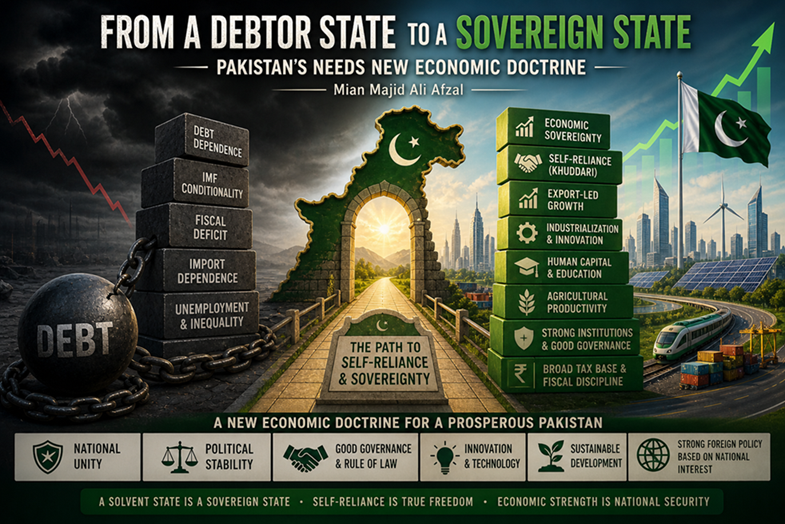
We need a stable and realistic doctrine that leads Pakistan from a debtor state to a sovereign state; we are currently facing a vicious cycle where it borrows just to pay the interest on previous loans. True sovereignty is seen as the ability to say no to external conditions such as IMF-mandated tariff hikes that may be detrimental to the local population. A solvent state is one where the domestic tax base is broad enough to fund its own defence and development without mortgaging state assets to foreign lenders. While Pakistan has historically monetised its geography for rent (the imported doctrines mentioned above), the new narrative pushes for Self-Reliance (Khuddari). This means building a foundation where foreign policy is dictated by national interest rather than the next loan tranche. Pakistan’s need now is not a religious or political one, but a mathematical one: a balanced budget and a surplus of exports, because a country that cannot pay its own bills cannot truly own its own soul. We must throw out the beggar’s bowl by achieving self-reliance and documenting the informal economy.
The writer is the author of “The Reforms” and serves as a Strategic and Administrative Adviser on South Asia Affairs for a CPEC-based project in Islamabad. He is also a Strategic Communication Adviser at the Institute of Strategic Communication & Economic Studies (ISCES). He can be reached at mianmajid582@gmail.com