
By Falak Sher Khan
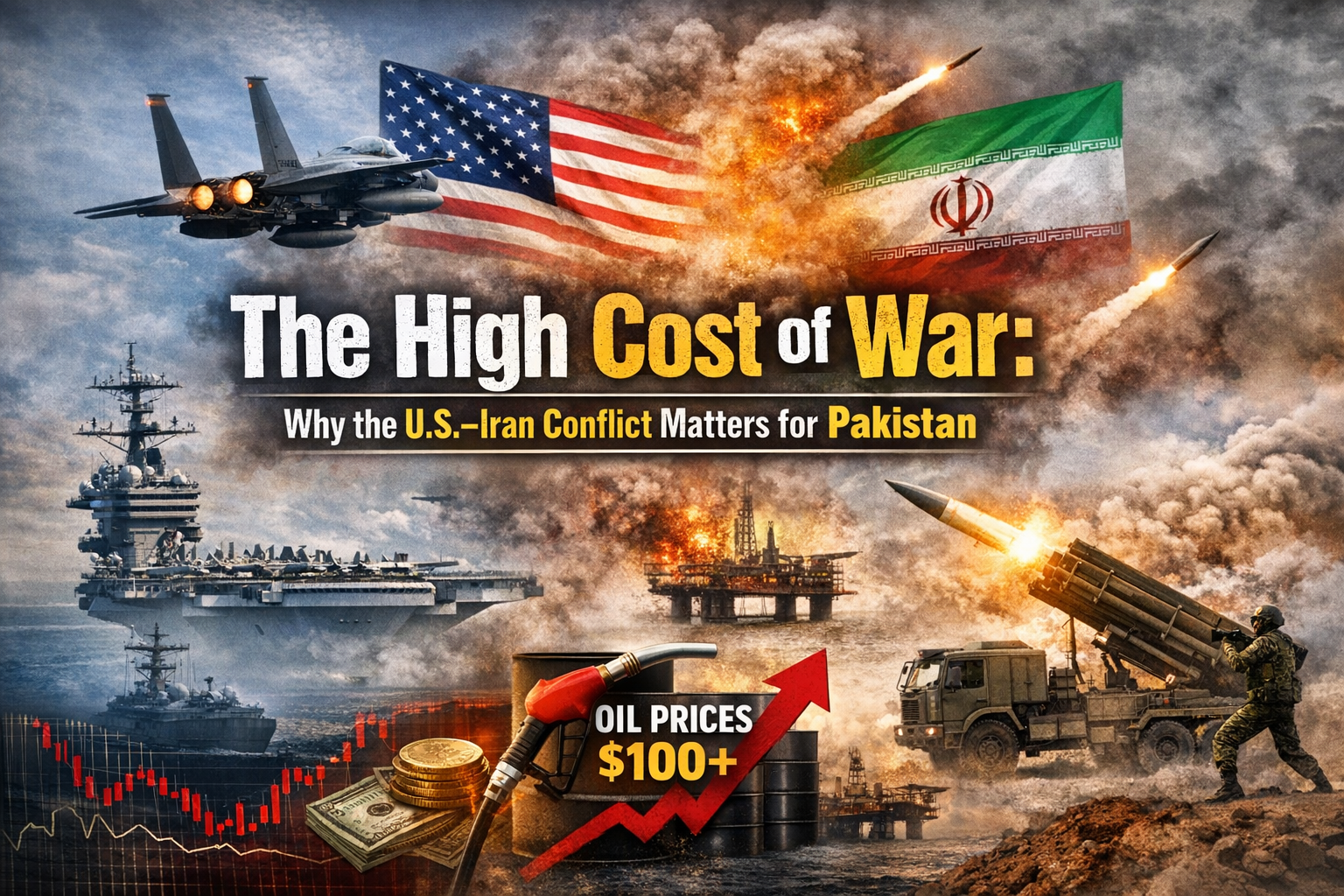
War in the twenty-first century is fought not only with missiles, aircraft, and soldiers, but also with vast financial resources. The ongoing confrontation between the United States and Iran illustrates this reality with remarkable clarity. Within the first 100 hours of the military campaign, often referred to as Operation Epic Fury, the United States reportedly spent about $3.7 billion, or nearly $890 million per day on military operations.
This staggering figure reflects the cost of sustaining modern military power: hundreds of combat aircraft in the air, warships deployed across the Persian Gulf, missile defense systems intercepting drones and ballistic missiles, and the constant use of precision-guided munitions costing millions of dollars each. Yet the financial implications of the conflict extend far beyond Washington’s defense budget.
The war has also shaken global energy markets, triggered volatility in stock markets, disrupted shipping routes, and increased the risk of global inflation. For countries like Pakistan heavily dependent on imported energy and vulnerable to global economic shocks, the consequences could be significant.
The Economics of Modern Warfare
The opening phase of the war revealed the enormous cost of modern military operations. In just a few days, the United States launched thousands of precision-guided weapons against Iranian targets, including cruise missiles, guided bombs, and armed drones. The cost of replenishing these munitions alone has been estimated at billions of dollars.
Military deployments have also been extensive. The conflict involves more than 200 combat aircraft, fleets of naval vessels operating in the Persian Gulf, and ground-based missile systems capable of long-range strikes. Maintaining this infrastructure requires enormous logistical support, including fuel supplies, maintenance operations, surveillance systems, and communication networks.
In addition, missile defense operations have proven particularly expensive. Interceptors used by systems such as Patriot or THAAD can cost between $4 million and $12 million per missile, while some Iranian drones reportedly cost only tens of thousands of dollars to produce.
This imbalance highlights a central paradox of modern warfare: defending against relatively inexpensive weapons can require extremely costly technology.
Beyond the direct costs of military operations, combat losses also add to the financial burden. Advanced aircraft, drones, and radar systems destroyed during the conflict represent billions of dollars in equipment that must eventually be replaced.
But while the financial cost to the United States is enormous, the war’s broader economic consequences may prove even more significant.
Oil: The Real Battlefield of the War
The Persian Gulf has long been the heart of the global energy system, and the U.S. Iran conflict has quickly turned oil markets into a secondary battlefield.
At the center of the crisis lies the Strait of Hormuz, one of the most important shipping routes in the world. Approximately 20 percent of global oil and natural gas supplies pass through this narrow waterway each day.
As tensions escalated and Iranian forces threatened shipping in the strait, tanker traffic declined sharply. The disruption triggered immediate reactions in global energy markets.
Within days, oil prices surged dramatically:
- Brent crude rose above $100 per barrel for the first time in years.
- In some trading sessions, prices briefly approached $120 per barrel.
- Analysts warn that prolonged disruptions could push oil prices toward $150 or even $200 per barrel.
Such increases have enormous implications for the global economy. Energy is a fundamental input for nearly every sector, from transportation and manufacturing to agriculture and electricity generation. When oil prices rise sharply, inflation tends to follow.
Economists warn that the current crisis could produce one of the largest energy supply disruptions in modern history.
Shockwaves in Global Stock Markets
Financial markets have also reacted sharply to the conflict. Historically, geopolitical crises tend to trigger uncertainty among investors, leading to rapid shifts in global capital flows.
Since the escalation of the war, global stock markets have experienced notable volatility. In one trading session during the conflict:
- The S&P 500 fell around 1.5 percent.
- The Dow Jones Industrial Average dropped nearly 739 points.
- The Nasdaq Composite declined 1.8 percent.
These declines reflect investor fears that rising oil prices could slow economic growth and increase inflation. Airlines, shipping companies, and other energy-intensive industries have been particularly affected.
At the same time, investors have moved money into so-called “safe-haven” assets such as gold and government bonds typical behavior during periods of geopolitical instability.
The war has therefore created a dual financial shock: higher energy costs combined with falling equity markets. For many economies, this combination can lead to stagflation, an environment of high inflation and low growth.
The Global Energy Crisis Risk
The conflict has already produced ripple effects far beyond the Middle East. Several analysts warn that if the war continues, it could trigger a prolonged global energy crisis.
Major shipping companies have temporarily halted operations in parts of the Persian Gulf, while airlines have rerouted flights due to airspace closures across the region.
Meanwhile, governments in Europe and Asia have begun considering emergency measures to stabilize energy supplies. Strategic petroleum reserves have been released to reduce price volatility, but analysts warn that these measures may only provide temporary relief.
The possibility of a prolonged disruption in oil exports from the Gulf region has raised fears of global recession.
What It Means for Pakistan
For Pakistan, the economic consequences of the U.S. Iran war could be particularly severe.
Pakistan imports a significant portion of its energy needs from international markets, including crude oil and liquefied natural gas. When global energy prices rise, the country’s import bill increases immediately.
If oil prices remain above $100 per barrel for an extended period, Pakistan could face several economic challenges:
1. Higher fuel prices
Already risen Petrol and diesel prices would likely rise more domestically, increasing transportation and logistics costs across the economy.
2. Rising inflation
Higher energy prices feed directly into the cost of electricity, food production, and industrial output, contributing to inflation.
3. Pressure on foreign exchange reserves
Pakistan’s oil import bill could increase by billions of dollars, placing additional pressure on already fragile foreign exchange reserves.
4. Currency depreciation risks
Higher imports combined with global financial uncertainty could weaken the Pakistani rupee.
These developments could complicate Pakistan’s ongoing efforts to stabilize its economy and manage external debt obligations.
Strategic Implications for Pakistan’s Foreign Policy
The conflict also raises important questions for Pakistan’s foreign policy and regional strategy.
Pakistan maintains historically complex relationships with both the United States and Iran. While Washington has long been an important security partner, Tehran is also a neighboring country with deep cultural, economic, and geographic ties to Pakistan.
A prolonged war in the region could create difficult diplomatic choices for Islamabad. Pakistan must balance several competing priorities:
- Maintaining stable relations with Gulf Arab states, especially Saudi Arabia.
- Preserving cooperation with the United States
- Avoiding tensions with neighboring Iran
- Protecting energy supplies and trade routes
At the same time, Pakistan must carefully monitor the security implications of the conflict. Instability in the Gulf could affect maritime trade routes and regional security dynamics, particularly in the Arabian Sea.
Lessons for Pakistan and the Developing World
The U.S. Iran conflict offers several broader lessons for developing countries.
First, it demonstrates that modern warfare is extraordinarily expensive. Even the world’s most powerful military must spend billions of dollars within days to sustain large-scale operations.
Second, it shows how regional conflicts can quickly transform into global economic crises. Energy markets, financial systems, and trade networks are deeply interconnected.
Finally, the war underscores the importance of diplomatic engagement and conflict prevention. For many developing countries, the economic consequences of war can be felt even when they are not directly involved.
Conclusion
The U.S.–Iran war illustrates a fundamental reality of modern geopolitics: military conflict today carries enormous economic consequences. Within days, billions of dollars have been spent on military operations. Oil prices have surged, stock markets have fluctuated, and fears of a global energy crisis have intensified. The disruption of the Strait of Hormuz, through which a fifth of the world’s energy supply flows, has made the conflict particularly significant for the global economy.
For Pakistan, the lesson is clear. In an interconnected world, distant wars can still affect domestic economies through rising energy prices, inflation, and financial instability. As the conflict unfolds, policymakers in Islamabad will need to navigate a complex landscape of geopolitical tensions and economic risks. The ultimate cost of the war may not be measured only in military expenditures, but in its lasting impact on global stability and economic security.

The author serves as Deputy Director General at the Institute of Strategic Communication & Economic Studies (ISCES) and previously held the appointment of Director Administration at DGPR, Pakistan Air Force. He has published extensively in leading national and international periodicals and is a specialist in strategic communication. He can be reached at ddg@iscesthinktank.org